
Pune: Two travel agencies duped of Rs 62 lakh in air ticket scam | Pune News

PUNE: The cyber police on Monday registered a case against online fraudsters for allegedly duping two prominent people travel agencies of Rs 62 lakh between April 16 and 17 by fraudulently using their prepaid account details to book flight tickets.
The cyber police have registered cases of cheating and common intention, and also invoked relevant sections of the Information Technology (IT) Act against the accused. According to senior inspector of the cyber police, Meenal Patil, the two travel agencies book air tickets in three private airlines for their clients. “They also book tickets on government airlines. For this purpose, they have prepaid bank accounts which are directly linked to the accounts of airlines,” Patil told TOI.
Patil said that the fraudsters purchased a total of 150 tickets of which two were for international flights. “They used fake ID proofs and misleading email IDs to book the tickets.
For people who had approached them for a ticket, police said, the fraudsters used original identity proofs. They used the money in the travel agencies’ accounts to purchase the tickets,” the cyber police officer added.
Police suspect that the data of prepaid accounts was leaked after which the scamsters used it to cheat the travel agencies.
“We suspect that some more travel agencies may have been defrauded by the scamsters in a similar way,” Patil said.
The fraudsters, according to the police, used different internet servers to book the tickets and received online payments to different bank accounts from the persons who booked the tickets.
Police said further investigation is on and it is trying to be ascertained as to which internet servers were used for making the transactions.
Last month, in a similar incident, a travel agent from the national capital was duped by online fraudsters of several lakhs.

Aussie travel agency, tour operator businesses grow by over 20% – KARRYON

Aussie travel agency, tour operator businesses grow by over 20% – KARRYON

As travel continues its post-pandemic comeback, travel agencies and advisors have never been busier. But likewise, the number of travel agency and tour operator businesses is booming.

According to Tourism Research Australia’s (TRA) Tourism Businesses Report 2017-2022in June last year, there were 8,647 travel agency and tour operator services based in Australia.

This is 1,502 more travel agency and tour operator businesses than there were in 2017 (7,145), reflecting a 21 per cent increase in the five years to June 2022.

While this is promising news for the sector, the number is still down 356 on the 9,003 businesses reported in 2020, which shows how the impact of the pandemic is still being felt.

Interestingly, the TRA report notes a significant increase in those operating as “mobile and very small travel agents”.

Aussie travel agency, tour operator businesses grow by over 20% – KARRYON

Home-grown

This could have something to do with the successes home-based and mobile agents are currently experiencing. For example, major mobile travel agency network TravelManagers Australia, has been reporting record sales months of late, with February 2023 business up a whopping 77 per cent on the same period in 2019. Its personal travel managers also saw their average commissions rise by more than 81 per cent.

“TravelManagers has received a lot of interest in our post-pandemic model and continues to grow with many experienced consultants and agency owners seeking a better way to run their business,” TravelManagers Australia Executive General Manager Michael Gazal told Karryon.

“The ‘work from home’ model has now become the standard, with the ability to reduce operating costs, which maximizes earning potential and provides true flexibility to choose your working days and hours to suit your circumstances.

“This combined with the freedom to choose your clients and areas of specialty, they can build a successful travel business that works for them.”

Travel = Big Business

The TRA report publishes an annual summary of the Australian Bureau of Statistics’ (ABS) count of tourism businesses in Australia.

Its key findings this year revealed 358,277 tourism businesses were operating across the country as of 30 June 2022, which is 19,233 more businesses than the previous year. This means one in seven Australian businesses (14 per cent) operate in the tourism sphere.

Most of the growth in tourism business numbers in 2021-22 occurred in three sectors: retail trade services (up seven per cent, by 10,422), cafes, restaurants and take-away services – including pubs, clubs and bars (up five per cent , by 4,735), and cultural, sports and recreation services (up ten per cent, by 3,390).

Small and micro tourism businesses (1-19 employees) make up most of the sector (48 per cent) while sole traders account for almost as many (47 per cent) tourism operations.

Eighty-five per cent of the total increase in businesses in 2021-22 were non-employing tourism businesses, including home-based and mobile travel agency models.

New South Wales (117,781), Victoria (111,400) and Queensland (64,038) account for 82 per cent of tourism businesses in Australia, although all states and territories saw an increase in tourism businesses in 2021-22.

Travel agents’ growing cruise sales may reverse trend to direct

Travel agents’ growing cruise sales may reverse trend to direct

A March bookings report and remarks from cruise executives indicate that travel advisors’ cruise bookings are rebounding.

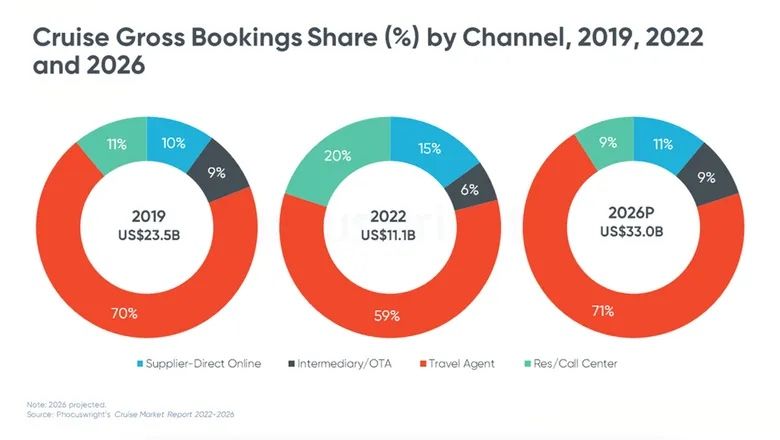
Travel agents’ proportion of cruise bookings tanked to an all-time low of 52% in 2021, down from 70% in 2019, as direct bookings gained traction, according to the US Cruise Market Report 2022-2026, released by Phocuswright.

But projections suggest concerns about an increase in direct bookings could be relatively short-lived, with the share of travel advisor bookings predicted to return to 2019 levels by 2025 and increase to 71% by 2026.

Travel agents’ growing cruise sales may reverse trend to direct

“Cruise was hit so hard and is coming back so strong,” said Michael Coletta, manager of research and innovation at Phocuswright and an author of the report. “As those itineraries get longer and more complex, it’s just not really a product that’s super well-suited for online booking.”

The pandemic ushered in an increase in direct cruise sales. According to the report, 21% of bookings came from direct sales in 2019, either through call centers (11%) or supplier websites (9%). But by 2022, the share of bookings from call centers nearly doubled, and direct online bookings increased, reaching a combined 35% share of cruise gross bookings.

That shift came as itineraries during the cruising restart were shorter and leaned domestic, making them simpler for guests to book directly, Coletta said. Meanwhile, he added, travel agents who were still working were dealing with cancellations and applying for future cruise credits for rebookings, which negatively impacted new bookings.

Now, Coletta sees evidence from the Phocuswright report, which looks at economic indicators, consumer research and interviews with industry executives, that booking share will change.

The cost of direct bookings

Carnival Corp. CEO Josh Weinstein said during a first-quarter earnings call last month that several of the company’s brands saw travel agent bookings exceed 2019 levels. Weinstein and other cruise executives have acknowledged the direct sales increase, but they have continued to reiterate their reliance on the trade.

Weinstein said during the call that advisors’ Wave season booking volumes were “phenomenal” and called the trade’s recovery “fantastic.”

“I’m not going to pretend that we don’t have direct business,” he said in an interview. “Of course, we do. But we will only be successful if all of our sales channels are successful. Truly. And I think the trade has done a remarkable job for this industry.”

That is especially true given how much growth is on the horizon for cruise lines. Coletta said the lines will need help filling beds in the years ahead, with 75 ships on order over the next five years.

Wall Street analysts are mixed on the value of bookings from advisors versus direct.

Truist Securities reported that Carnival Corp. Insist it is more accretive for guests to speak with one of their cruise line agents to book a $250 cruise than to pay commission to an agent to book it, in part because those calls are sent to places with lower operating costs such as the Philippines.

In contrast, Assia Georgieva, a longtime cruise analyst and a principal at Infinity Research, said, “Travel agents are cheaper than operating a call center.” But he also predicts that the direct booking channel could hold onto its stronger position down the line, and well past 2026, as the tech-savvy Generation Z grows into a larger share of cruise customers.

Travel agents report strong sales

Travel agents say they are confident in their ability to reclaim the greater share of gross bookings.

Although Robin Sanchez, president of Montecito Village Travel, instructed her agents to stay in touch with their clients early during the pandemic, she said some of those advisors took a break.

“They just kind of tapped out,” Sanchez said. That left clients to be poached by other advisors or to work directly with cruise lines, she said.

But she’s seeing a strong recovery in 2023. Her company has recorded $49 million in sales for cruise travel so far this year, compared with $44 million for all of 2019. Her staff is also back to full strength after she hired back all her employees and added more than 100 independent contractors since 2020.

Cruise Planners founder and CEO Michelle Fee said business is strong this year and that overall cruise bookings for 2023 are 25% over the full year of 2019. She said she’s not worried about the recent increase in direct business to cruise lines.

“There’s so much travel out there, and there’s so much opportunity,” she said. “Obviously, we’d love for it all to go through the travel agent channel, but for me, it’s never stopped our business.”

*This story originally appeared in Travel Weekly.

Phocuswright Europe 2023

Ready to discuss and debate the future of the industry and where do we go from here? Join Phocuswright Europe in Barcelona, ​​June 12-14.

Gold Coast hosts Chinese travel agency bosses at Australian Tourism Exchange

Gold Coast hosts Chinese travel agency bosses at Australian Tourism Exchange

Australia has rolled out the red carpet for the most important group of tourists to visit the country in the past three years.

A 133-strong delegation of Chinese travel agency bosses and industry wholesalers has touched down on the Gold Coast for the Australian Tourism Exchange — Tourism Australia’s flagship industry conference.

The powerbrokers are the key to reviving an international tourist market worth $12.4 billion to the Australian economy each year.

The Chinese VIPs will be wined, dined, and granted exclusive access to the country’s premier tourism experiences, attractions, and destinations over the course of the five-day junket.

The host city’s sales pitch includes 25 “familiarizations”, giving buyers the chance to take surfing lessons or shape their own board, go jet boating, hot air ballooning, or visit the region’s best wineries and craft breweries.

a large group of chinese travel agents waving together

Chinese travel agents hold the key to Australian tourism’s $12.4 billion problem.(ABC Gold Coast: Dominic Cansdale)

Nearly 1.5 million Chinese tourists traveled to Australia every year before the pandemic, and 20 per cent of them booked pre-paid holiday packages.

Securing a spot on the itineraries was considered a major win for airlines, hotels, and tour operators.

The Australian Tourism Exchange is where many of those deals get done.

Reder Wang, managing director of Shenzhen CEPT International Travel Service, has been selling Australian holiday packages for two decades.

A man stands with his hands behind his back at a tourism conference on the Gold Coast.

Reder Wang has back-to-back meetings with Australian businesses this week.(ABC Gold Coast: Mackenzie Colahan)

His schedule this week was almost full, but that didn’t stop the keen golfer from sneaking in a round at the exclusive members-only course The Pines, at the InterContinental Resort at Sanctuary Cove, courtesy of Destination Gold Coast — the city’s peak tourism body.

Mr Wang said Australia remains the number one long-haul destination for the Chinese because of its unique landscape, native animals, as well as the seafood and steak.

“There is a great demand in China,” he said.

“Because of COVID-19, we have been locked up for three years.

“For most of our product packages, people stay at least two nights on the Gold Coast because of the long beaches and the theme parks.

“I can see Tourism Australia really has a very long strategy for China.”

Chinese tourists have not returned as quickly as the industry had hoped.

Only 40,000 arrived in Australia in February, up from 15,000 in January.

The aviation capacity between the countries is at 42 per cent of pre-COVID levels.

Aerial view of tourism industry delegates talking in stalls.

About 2,500 delegates are on the Gold Coast for the Australian Tourism Exchange.(Supplied: Tourism Australia)

Tourism Australia’s internal projections suggest the numbers will not recover until 2026.

“We have missed you”, was the message to the delegates during a special welcome attended by diplomats from the Chinese Embassy in Canberra.

Executives from Tourism Australia and each of the state’s peak tourism bodies will travel to Chengdu next month for the Chinese launch of the Come and Say G’day advertising campaign, which was unveiled to the rest of the world in October last year.

A woman, smiling, in a red jacket.

Phillipa Harrison says China is our most important tourist market “by far”.(ABC Gold Coast: Mackenzie Colahan)

Tourism Australia managing director Phillipa Harrison said Chinese visitors were desperately needed to offset the number of Aussies who were “traveling outbound in droves”.

“It remains a critical market for us,” he said.

“It is worth $12.4 billion so we are looking forward to that return.

“The tourism industry will not recover fully until China comes back.”

5 reasons to use a travel agent when booking your next trip

We’re a few weeks into the new year, which is the best time to start planning your next trip (or trips!) for 2023. Canadians across the country are back to travelling, with airports reporting some of the busiest travel dates since the start of the pandemic. But before you jump online to book your trip, here are five reasons you should use a travel agent to plan the perfect vacation.

1. Travel agents have the latest travel advice

Over the last few years, travelers have trusted the advice and guidance of travel agents to help plan their next trip. They have the latest information on travel advisories and can help you choose a safe, comfortable place to visit, and will keep you informed on changes, so you don’t face unwelcome surprises when it’s vacation time.

At CAA Travel, all consultants are CAA Travel SMART certified and have all the tools needed to plan holidays in the post-pandemic world.

2. They have your back when you need them

We’ve seen how staff shortages and increased demand have impacted travelers this past year. Over the holidays, many flights were canceled or delayed, leaving Canadians scrambling at the airport. That’s where a travel agent steps in. If something happens before you leave or while you’re away, your travel agent is ready to jump into action and help you get things sorted out. They’ll even make calls to airlines, hotels, and travel operators on your behalf – and wait on hold so you don’t have to.

3. You’ll know you’re protected with the right travel insurance

In addition to preparing the perfect trip, travel agents will make sure you have the right coverage to protect you and your wallet. Emergency medical insurance covers you and your family if you get sick or injured while traveling, helping you avoid costly medical bills. Trip cancellation and interruption insurance is growing increasingly popular among travelers, protecting Canadians from financial stress if their flights are canceled or their trip is otherwise delayed and interrupted. While credit card benefits and group plans can provide some coverage, you might need top-up insurance for your journey. A travel agent can work with you to identify any gaps in coverage and make sure you have the right policy for your trip.

It can be overwhelming with the number of coverage options available. But if you book an appointment with a CAA Travel Consultant, you can travel worry-free knowing you have comprehensive coverage with CAA Travel Insurance. And if you’re a CAA Member, you’ll also save up to 20%* on your policy.

4. They’ve seen the world and know all the best places

Whether it’s your first trip in a while or you’re a seasoned traveller, everyone can benefit from first-hand experiences. Travel agents regularly visit popular destinations and hidden gems around the world to bring you personal recommendations and insights to help you find the ideal destination.

They keep up to date with the latest travel trends and can draw from their previous trips to share insider knowledge on the best cruise lines, can’t-miss guided tours, or picture-perfect seasons to visit different parts of the world.

5. Travel agents save you time and money

We often think that shopping online helps find the lowest costs, but that isn’t always the case. Travel agents have resources most people can’t access to research, plan, and book travel arrangements, which helps them get the best travel options at the best price.

CAA Travel Consultants know the market’s best deals, the right time to book, and they’ll do the heavy lifting so all you need to do is focus on enjoying your vacation. And CAA Members get exclusive travel benefits with preferred cruise and guided tour partners.

Planning a trip is exciting, but it can be overwhelming. Whether you’re looking for a relaxing respite, an adventurous expedition, or a historic holiday, a CAA Travel Consultant can help you book the trip of your dreams. Book an appointment with a local CAA Travel Consultant today, or learn more about planning a trip with CAA Travel to get started.


CAA Travel Insurance is underwritten by Orion Travel Insurance Company, a CAA Company. Certain exclusions, limitations and restrictions apply. Subject to change without notice. A Medical Questionnaire is required if you are 60 years of age and older. Quotes are valid for 30 days.


*Applies to CAA Members in good standing (CAA Membership dues paid in full by Membership expiry date). Up to twenty percent (20%) savings applies to the total premium excluding applicable taxes. Minimum premium applies. Subject to change without notice. Excludes Visitors to Canada Insurance. CAA Everyday, Classic®, and Plus® Members save 10%. CAA Premier® Members save 20% at CAA Stores or by calling 1-800-267-8713. CAA Premier Members save 10% and earn 10% in CAA Dollars® when booking online.


® CAA trademarks are owned by, and use is authorized by, the Canadian Automobile Association.

Helloworld Travel agent goes bust, leaving would-be travelers out of pocket

Helloworld Travel agent goes bust, leaving would-be travelers out of pocket

Melbourne man Geoff Berlowitz isn’t big on holidays.

“I mean, Coburg would be a big trip for me,” he said with a wry smile, referring to the suburb just down the road.

So, in 2019, when he and his wife Margaret paid $22,500 for a tour to see Canada and Alaska, scheduled for May 2020, it was a big deal.

“We didn’t sort of spare any expense. We thought bugger it, let’s just spend it and have a good time,” he said.

Then the coronavirus pandemic hit in March 2020, their trip was cancelled, and they waited for their travel agent — Helloworld Travel Plenty Valley — to get them a refund or a credit from the tour operator.

“Each month it was excuse after excuse…. but the main thing he was saying was he was waiting on Evergreen [the tour operator] to return the money,” Margaret said.

But Evergreen later told the family the travel agent had only ever paid them the deposit.

The Helloworld franchisee lost $21,500 of their money, as the Mill Park business slowly went under.

In July this year, it went into liquidation, owing the Berlowitzs and 55 other customers a combined $340,000, according to administrator Mackay Goodwin.

Helen Harrison is also owed $7,000 from the travel agent.

A family of four.

The Harrison family — Charlotte, David, Helen, and Elise — say money which was refunded to Helloworld was not returned to them.(ABC News: Daniel Fermer)

She had booked airline tickets for her family to travel to the United States in March last year — one final family holiday before her daughters finished high school.

After she canceled the trip, she was told repeatedly by the store that the airline wasn’t issuing refunds, and she’d need to take a credit.

“So we thought, well, that’s better than nothing,” she said.

After the store went into liquidation, she was told by the airline that it had refunded her money in April this year.

Helloworld Travel Plenty Valley held on to it before going under three months later.

“Realizing that somebody actually got your money back and then didn’t bother to let you know, when you’ve been chasing it for 12 months, it’s just awful,” Ms Harrison said.

“$7,000 is a lot of money to lose … we’d saved up for a few years for it,” she said.

The Helloworld store.

Helloworld Travel Plenty Valley went bust in 2020, owing $340,000 to scores of customers for holidays they were unable to take because of the pandemic.(ABC News: Daniel Fermer)

The Plenty Valley store was the latest of at least four Helloworld Travel agencies to go bust in Melbourne’s north and east.

In February, Helloworld Travel Monbulk and Bentleigh went into liquidation, owing $68 thousand to 53 clients, while in September 2020, Helloworld Belgrave went under.

The franchiser, Helloworld Travel, has 2,224 stores across Australia and is worth $280 million, but Margaret Berlowitz said when she asked the head office to give her money back, they wiped their hands of the issue.

“They virtually said ‘It’s not our problem. It’s a franchise’,” she said.

The Berlowitzs say the only reason they booked with Helloworld, and not an independent agent, was because they assumed they were dealing with a big company and their money would be safe.

“We presumed Helloworld was all one company, under one name,” Margaret said.

Helen has also been demanding that the head office give her her money back, to no avail.

“It’s just not good enough,” she said.

Helloworld Travel declined to respond to questions about the issue.

Last week, reflecting a horror 18 months for the travel industry, it posted an un-audited full-year loss of $35.9 million.

Calls for better regulation of travel agents

Consumer advocate Adam Glezer said the situation showed the need for better regulation of all travel agents, including the use of trust accounts for customer funds.

“Lawyers require them, real estate agents require them,” he said.

“Why are they not required with travel agents?”

The government-run Travel Compensation Fund (TCF) used to cover consumers in the event that a travel agency went bust, but it was abolished in 2014.

Agencies are now self-regulated, through the Australian Federation of Travel Agents (AFTA), which also represents Helloworld Travel.

In a statement, AFTA said more regulation of travel agents was not necessary and its agents had been tireless in their efforts to secure refunds and credits for people who couldn’t travel due to COVID-19.

It says travel agents who are members of the International Air Transport Association (IATA) are required by that organization to maintain a trust account for airline ticket purchases.

“Additionally, travel agents should already have a trust or client account [for other transactions],” the statement said.

“Consumer and Criminal Law applies to all agencies as with the wider population, and, while not commenting specifically on any case, remedies are already in place for breaches including for fraud.”

None of the Helloworld franchisees are facing any criminal or civil charges and no suggestion is made by the ABC that they are involved in any criminal conduct.

Mr Glezer, who runs Facebook pages for would-be travelers left in the lurch during the pandemic, believes more needs to be done to prevent travel agents spending customer money on expenses other than the holidays that customers have booked.

“What we have got to do is actually fix the problem that is in front of us to ensure this does not happen moving forward,” he said.

In June, Liberal MP Kevin Andrews put a motion to federal parliament for better regulation in the industry, which was seconded by Labor MP Michael Freelander.

The issue has stalled since then.

But for the Berlowitzs and the Harrisons, the fight with Helloworld Travel continues.

“I’m not going to let this go,” Ms Harrison said.

“Just wiping their hands of this is unacceptable.”

For Geoff Berkowitz, the experience has left such a bad taste, he said he probably wouldn’t travel overseas again.

“I’d rather spend money on something else,” he said.

Posted , updated

Death of the travel agent: Covid-19 an existential threat for an industry without ‘any product to sell’ | Business

Qravel agencies are facing an “existential threat” as continuing border closures mean they “don’t have any product to sell”, with business analysts predicting the phasing out of government wage subsidies is likely to mean most larger agencies survive.

However, some travel agencies, despite reporting “zero revenue” since the pandemic began and having to pay back fees for canceled holidays, hope that – by sparing their clients lengthy phone calls with airlines by negotiating refunds on their behalf – they will have demonstrated their value to customers eager to travel when restrictions allow it.

Travel websites’ surging share of holiday bookings over the past decade – Webjet recorded 52% growth in bookings between 2013 and 2019 – has seen smaller travel agencies close and larger firms move to compete with the online and corporate travel markets.

But agencies that have exclusively relied on jobkeepers are concerned they will not be able to recover like other sectors when the scheme is wound back after September.

Flight Centre’s founder and managing director, Graham Turner, told ABC radio on Tuesday the sector needed federal and state governments to be clearer on whether they were pursuing elimination or suppression, and bring certainty for what travel will be allowed.

“We really need the domestic borders open initially and then the international borders to open,” he said. “The jobkeeper helps a bit but that’s not the real issue. Our main problem we’ve got is we don’t have any product to sell.”

Flight Center founder Graham Turner says jobkeeper is not the real issue. ‘Our main problem we’ve got is we don’t have any product to sell.’ Photograph: Glenn Hunt/AAP

As a result of travel restrictions, Flight Center has had to reduce staff numbers from 22,000 to 5,000. Helloworld Travel this week launched a $50m capital-raising exercise to bolster its balance sheet, with transaction volumes expected to remain at 10%-12% of previous levels until state borders fully reopen. It has reduced operating costs from about $23m to about $2m a month, and has stood down 700 of its 1,500 staff, with the other 800 working reduced hours.

When new figures released on Thursday showed unemployment had risen to 7.4% in June, the opposition minister for employment and small business, Brendan O’Connor, held a press conference with a travel agent to call for an extension of jobkeeper to keep tourism workers employed .

Andrew Buerckner, the Melbourne travel agent appearing with O’Connor, said 23 of his 25 staff would not be employed without a jobkeeper, and predicted “98% of travel agencies in Australia would be gone” without the subsidy.

“As much as I hate the word ‘pivot’, there is very little chance for the travel industry to pivot into another area,” he said. “Hospitalities have the opportunity to look at takeaways and minimize their operations but still have incremental revenue. For us, we haven’t really had any revenue since March.”

Gloria Gammo, who runs Sydney-based luxury travel specialist GG Inspired, has relied on jobkeeper as income for her and her assistant since international borders closed at the beginning of the pandemic.

Gloria Gammo, who runs GG Inspired, has relied on jobkeeper as income for her and her assistant since international borders closed. Photograph: Gloria Gammo

She told Guardian Australia that not only had income ground to a halt, her small business “now spends all of our time repaying money back to clients” and negotiating refunds with airlines for trips that have been cancelled.

Gammo has also “been getting commission recalls on past bookings” for holidays that never go ahead.

“We now make zero revenue,” he says. “Not only are we working for free to negotiate refunds with hotels and airlines, but we’re having to pay back money, and our future revenue that we had projected is gone because you only get paid when the client stays.

“You have to make peace with how many thousands you’ve had to return.”

However, Gammo says forced cancellations of holidays have shown the value in booking through a travel agent, as they chase up refunds on behalf of clients and have their own access to booking systems.

She says clients who had their trips canceled are rebooking intrastate getaways with her, and that those who had to postpone international honeymoons are organizing domestic, multi-leg “mini-moons” in the meantime.

“I remember being on hold with Scenic tours for two hours, and this was on their line for travel agents, and then speaking to them for six hours to organize a refund for a trip happening that day,” she says. “Those clients will only ever remember what you did for them.”

Official complaints about online travel bookings have risen fourfold since the pandemic began, with the Australian Competition and Consumer Commission receiving 9,941 complaints from 1 January to the end of May, compared with 2,324 complaints in the same period in 2019.

Despite the complaints, Brian Han, a senior equity analyst at Morningstar, believes “pure bricks and mortar” stores that have become “increasingly marginalised” with the growth of online now faced an “existential threat”.

“Coronavirus has accelerated the migration of shopping behavior from physical stores to online in many sectors,” he says. “There are fewer and fewer reasons why you would physically walk into a store now, and that will extend to travel agents [when travel restrictions are lifted].”

Han says while travel agents have traditionally survived on larger commissions, “online players take a smaller cut and still do pretty well” because they don’t have to pay for real estate.

Han predicts that when pandemic-induced restrictions are lifted, “bigger players” such as Flight Center will “become even stronger because smaller agencies have fallen by the wayside” and won’t be able to hibernate their businesses for long enough to ride the wave of “pent-up demand for travel”.

He says this is because businesses such as Flight Center have already begun moving into overseas markets, building online brands (BYOJet and Aunt Betty) and targeting corporate clients.

Pierre Benckendorff, an associate professor of tourism business at the University of Queensland, also believes smaller travel agents “are in quite a bit of strife”.

“If anybody is going to survive, a big organization like Flight Centre, with deep pockets, will stand a pretty big chance,” he says.

Benckendorff says many independent travel agents based in suburban and rural centers were forced to specialize in complicated itineraries or became part of bigger chains around the time of the dotcom boom.

Han says this trend will intensify, and that most travel agents will exist for complicated, luxury trips and corporate travel.

“For a seven-stop itinerary across Africa you might think ‘bugger it I’ll go to a travel agent’,” he says. “But for a three-night trip to Melbourne, online is easier and cuts out a very expensive middleman. Why would you bother going to an agent?”

Picking a Travel Agent? 4 Things to Know

So, you’re thinking about traveling again? You’re not alone. The pandemic may not be over, but the expansion of vaccine eligibility in the United States — hiccups, delays and pauses aside — plus the news that the European Union will be opening up to vaccinated travelers is inspiring many to plan a real-deal summer vacation , or even take the leap on booking bucket-list adventures.

Travel remains far from simple, however. The virus is finding new footholds around the world, leaving an ever-changing set of rules and restrictions in its wake (and all of this is compounded by a run on home rentals, rental cars and more). It’s a reality that’s inspired many DIY-inclined travelers to consider working with a travel agent, or travel advisor, for the first time, in the hopes of skipping the travel-planning stress and focusing on actually relaxing on vacation instead.

Most travel advisors provide their services free of charge to clients (though some charge a booking fee, which can range from $25 to $100, depending on how complicated a trip you’re having) and instead make their money through commissions from hotels, tour operators , cruise lines, airlines and other travel companies.

Finding the right advisor for you is “like finding a hairdresser,” says Erika Richter, the senior communications director of ASTA, the American Society of Travel Advisors. “You want someone who understands your personal style.”

Ms. Richter, along with Misty Belles, the managing director of global public relations for Virtuoso, an international travel agency network specializing in luxury travel, shared their tips on how you can find an adviser who will understand you and your dream trip.

Start by asking trusted friends and family members for recommendations. “The same holds true for any professional service in your life,” Ms. Belles said. “If you know someone who is working with a travel advisor and was pleased with the experience, that’s a great place to start.”

If that’s a no-go (or if your friends and family, while beloved, don’t have the same travel style as you do), Ms. Richter strongly suggested seeking out local businesses where you live.

“Supporting small businesses in our communities is more important than ever right now,” she said. ASTA has a directory that allows you to search for advisers close to you; a quick Google search will likely do the trick, too, Ms. Richter said.

Another way to find a travel advisor is to look for one out based on a destination, or destinations, that he or she may specialize in. Are you interested in going to a specific Caribbean island nation? You’ll likely want to work with an adviser who has booked a number of trips in that country, and has connections and contacts there. Some advisors specialize in trips to Disney resort properties; others focus on cruises. If you’re interested in planning a trip outside of their purview, advisors can refer you to someone else within their network, or do the heavy-duty research themselves.

“Choosing someone who specializes in a destination is a good first foray into working with a travel advisor,” Ms. Belles said. “But when you work with the same adviser for a while, they become a specialist in you.”

Speaking of what you want, it can be useful to understand the organization, or organizations, an adviser is associated with. Whether they work alone, with one partner in a small shop, or as part of a large agency, they are likely connected to a consortium, or a professional network, like Virtuoso, which is made up of more than 1,000 agencies in 50 countries around the world, or ASTA itself.

“Obviously, I represent ASTA, but I do think it’s important to look at an adviser’s professional affiliations,” Ms. Richter said. Affiliations can serve as a vote of confidence that the adviser has vetted; it also gives you a chance to recourse should you find yourself unhappy with your relationship (ASTA, for example, can handle consumer complaints and be a part of the resolution process). Some consortiums specialize in a certain type of travel — Virtuoso agencies focus on luxury travel, for example, while others might highlight adventure travel, or family trips and so on.

An adviser’s affiliations also act as a conduit for one of their major selling points: traveler perks.

“Ask them what kinds of benefits they get from their professional networks,” Ms. Richter said. “Upgrades, free breakfasts, late checkouts when available — who doesn’t want some of those freebies?”

Do you like leisurely, slow trips? Packaged itineraries filled with sightseeing and attractions? Do you like to travel alone, or are you planning multigenerational trips with children and grandparents? Ensuring that your advisor understands what you want — and maybe even establishing that they have a similar travel style themselves — can greatly help with building rapport (and allow them to plan an even better trip for you).

Some important questions to ask: Do they charge a planning fee? What are some examples of trips that they’ve planned in the past?

“Be really upfront about your budget for a trip, and be sure that that is something they can help you make the most of,” Ms. Richter said.

Ms. Belles suggested asking the adviser how they personally like to travel, and some of their favorite destinations.

“Interview them a little bit! You can see whether there are some similarities there,” she said. But make sure they’re asking you just as many questions.

“If they’re not, that should be a red flag,” said Ms. Belles. “An adviser should be looking to get to the heart of what exactly you want as a traveler.”