Death of the travel agent: Covid-19 an existential threat for an industry without ‘any product to sell’ | Business

Qravel agencies are facing an “existential threat” as continuing border closures mean they “don’t have any product to sell”, with business analysts predicting the phasing out of government wage subsidies is likely to mean most larger agencies survive.

However, some travel agencies, despite reporting “zero revenue” since the pandemic began and having to pay back fees for canceled holidays, hope that – by sparing their clients lengthy phone calls with airlines by negotiating refunds on their behalf – they will have demonstrated their value to customers eager to travel when restrictions allow it.

Travel websites’ surging share of holiday bookings over the past decade – Webjet recorded 52% growth in bookings between 2013 and 2019 – has seen smaller travel agencies close and larger firms move to compete with the online and corporate travel markets.

But agencies that have exclusively relied on jobkeepers are concerned they will not be able to recover like other sectors when the scheme is wound back after September.

Flight Centre’s founder and managing director, Graham Turner, told ABC radio on Tuesday the sector needed federal and state governments to be clearer on whether they were pursuing elimination or suppression, and bring certainty for what travel will be allowed.

“We really need the domestic borders open initially and then the international borders to open,” he said. “The jobkeeper helps a bit but that’s not the real issue. Our main problem we’ve got is we don’t have any product to sell.”

Flight Center founder Graham Turner says jobkeeper is not the real issue. ‘Our main problem we’ve got is we don’t have any product to sell.’ Photograph: Glenn Hunt/AAP

As a result of travel restrictions, Flight Center has had to reduce staff numbers from 22,000 to 5,000. Helloworld Travel this week launched a $50m capital-raising exercise to bolster its balance sheet, with transaction volumes expected to remain at 10%-12% of previous levels until state borders fully reopen. It has reduced operating costs from about $23m to about $2m a month, and has stood down 700 of its 1,500 staff, with the other 800 working reduced hours.

When new figures released on Thursday showed unemployment had risen to 7.4% in June, the opposition minister for employment and small business, Brendan O’Connor, held a press conference with a travel agent to call for an extension of jobkeeper to keep tourism workers employed .

Andrew Buerckner, the Melbourne travel agent appearing with O’Connor, said 23 of his 25 staff would not be employed without a jobkeeper, and predicted “98% of travel agencies in Australia would be gone” without the subsidy.

“As much as I hate the word ‘pivot’, there is very little chance for the travel industry to pivot into another area,” he said. “Hospitalities have the opportunity to look at takeaways and minimize their operations but still have incremental revenue. For us, we haven’t really had any revenue since March.”

Gloria Gammo, who runs Sydney-based luxury travel specialist GG Inspired, has relied on jobkeeper as income for her and her assistant since international borders closed at the beginning of the pandemic.

Gloria Gammo, who runs GG Inspired, has relied on jobkeeper as income for her and her assistant since international borders closed. Photograph: Gloria Gammo

She told Guardian Australia that not only had income ground to a halt, her small business “now spends all of our time repaying money back to clients” and negotiating refunds with airlines for trips that have been cancelled.

Gammo has also “been getting commission recalls on past bookings” for holidays that never go ahead.

“We now make zero revenue,” he says. “Not only are we working for free to negotiate refunds with hotels and airlines, but we’re having to pay back money, and our future revenue that we had projected is gone because you only get paid when the client stays.

“You have to make peace with how many thousands you’ve had to return.”

However, Gammo says forced cancellations of holidays have shown the value in booking through a travel agent, as they chase up refunds on behalf of clients and have their own access to booking systems.

She says clients who had their trips canceled are rebooking intrastate getaways with her, and that those who had to postpone international honeymoons are organizing domestic, multi-leg “mini-moons” in the meantime.

“I remember being on hold with Scenic tours for two hours, and this was on their line for travel agents, and then speaking to them for six hours to organize a refund for a trip happening that day,” she says. “Those clients will only ever remember what you did for them.”

Official complaints about online travel bookings have risen fourfold since the pandemic began, with the Australian Competition and Consumer Commission receiving 9,941 complaints from 1 January to the end of May, compared with 2,324 complaints in the same period in 2019.

Despite the complaints, Brian Han, a senior equity analyst at Morningstar, believes “pure bricks and mortar” stores that have become “increasingly marginalised” with the growth of online now faced an “existential threat”.

“Coronavirus has accelerated the migration of shopping behavior from physical stores to online in many sectors,” he says. “There are fewer and fewer reasons why you would physically walk into a store now, and that will extend to travel agents [when travel restrictions are lifted].”

Han says while travel agents have traditionally survived on larger commissions, “online players take a smaller cut and still do pretty well” because they don’t have to pay for real estate.

Han predicts that when pandemic-induced restrictions are lifted, “bigger players” such as Flight Center will “become even stronger because smaller agencies have fallen by the wayside” and won’t be able to hibernate their businesses for long enough to ride the wave of “pent-up demand for travel”.

He says this is because businesses such as Flight Center have already begun moving into overseas markets, building online brands (BYOJet and Aunt Betty) and targeting corporate clients.

Pierre Benckendorff, an associate professor of tourism business at the University of Queensland, also believes smaller travel agents “are in quite a bit of strife”.

“If anybody is going to survive, a big organization like Flight Centre, with deep pockets, will stand a pretty big chance,” he says.

Benckendorff says many independent travel agents based in suburban and rural centers were forced to specialize in complicated itineraries or became part of bigger chains around the time of the dotcom boom.

Han says this trend will intensify, and that most travel agents will exist for complicated, luxury trips and corporate travel.

“For a seven-stop itinerary across Africa you might think ‘bugger it I’ll go to a travel agent’,” he says. “But for a three-night trip to Melbourne, online is easier and cuts out a very expensive middleman. Why would you bother going to an agent?”
How this man fought for $5,200 after a travel agency spent his airline vouchers — on other clients

How this man fought for ,200 after a travel agency spent his airline vouchers — on other clients

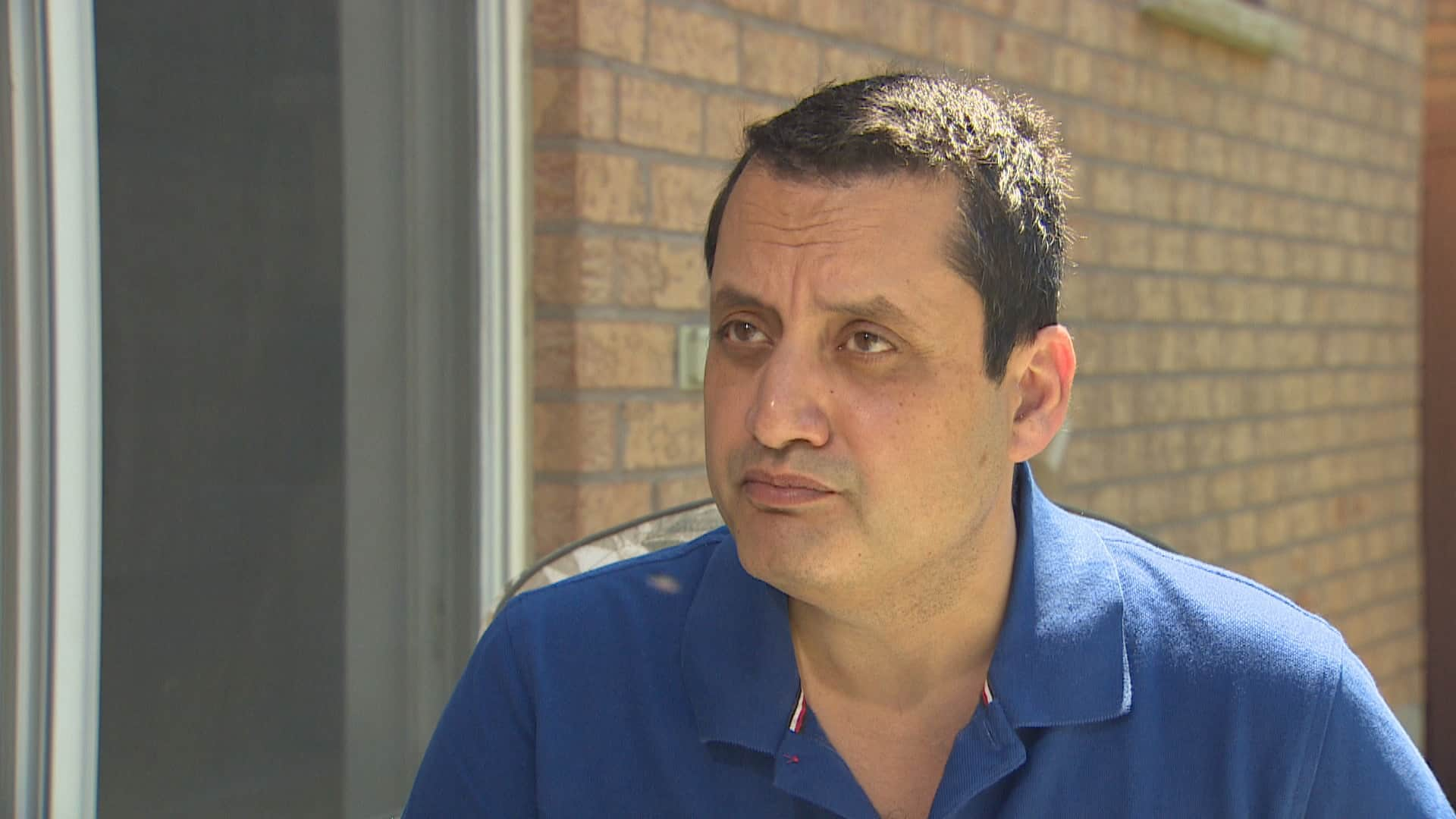
Surinderpal Gill trusted the travel agency where he bought tickets for a family trip to India two years ago.

But then he found himself out more than $5,200 and his trust was broken.

Last June, Air Canada sent All Link Travel, based in Toronto, three vouchers to compensate Gill for return flights that were canceled as aviation ground to a halt amid the pandemic.

But instead of telling him, Gill says the travel agency repeatedly said there was no sign of the valuable travel documents. It then used those vouchers to pay for trips for other people.

“I feel like I have been betrayed,” he told Go Public, shaking his head in disbelief in his Brampton, Ont., home. “How can somebody use my money without my consent?”

Gill is one of thousands of Canadians who’ve battled for months over travel vouchers issued amid the pandemic. Many say the very travel agencies they use are compounding their problems getting vouchers or refunds from airlines.

“The bane of our existence … the infamous travel voucher,” said Richard Smart, CEO and registrar of the Travel Industry Council of Ontario (TICO), which regulates travel agencies. “Complaints have gone through the roof over the last two and a half years.”

The Canadian Transportation Agency (CTA) says it, too, has received thousands of such complaints — almost 9,000 since the pandemic was officially declared in March 2020.

After Go Public got involved, the agency paid Gill.

Travel vouchers drained

Gill, his wife, two sons and five other family members were in India that March, and were desperate to find a way back to Toronto after their return flight was cancelled.

He paid almost $11,000 for four tickets to get his immediate family on a flight organized by the federal government; almost triple the usual cost.

WATCH | Fighting for his $5,200:

How this man fought for ,200 after a travel agency spent his airline vouchers — on other clients

‘It wasn’t their money,’ says Surinderpal Gill

Surinderpal Gill was angered by his travel agency’s use of his travel vouchers for other customers, and suggested an alternative way airline refunds should be administered.

“There were no more options,” he said. “We had no choice.”

When Air Canada received a government bailout in April 2021 and promised to compensate travelers whose flights had been cancelled, Gill waited a couple of months and then called his travel agency to find out when his vouchers were coming.

“They said they don’t have any information,” said Gill.

He says he called several more times over the next few months and, each time, was told Air Canada hadn’t emailed any vouchers for him.

Last December, Gill asked Air Canada directly. He was told All Link had had the vouchers since June.

The airline sent him the same email it had sent All Link, which included a PIN, to log in and check the balance. That’s when Gill learned the vouchers — worth $5,277 — had been almost completely drained.

“I was angry,” he said. “This is misuse of money.”

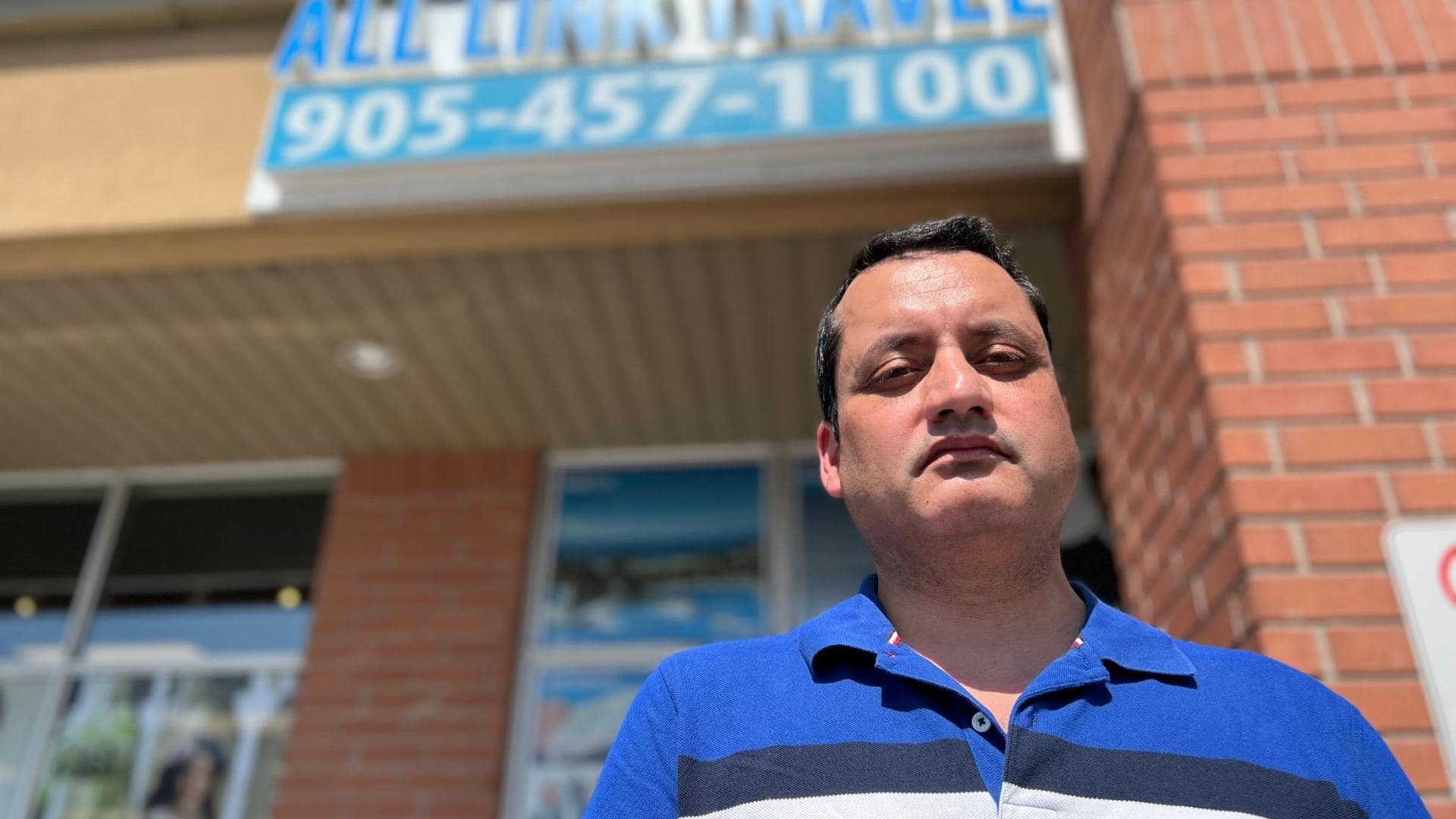
All Link Travel, in east Toronto, repeatedly told Surinderpal Gill of Brampton, Ont., the vouchers had not arrived from Air Canada. (Kimberly Ivany/CBC)

The agency claimed the vouchers had been used by mistake — three times.

“I said … ‘Don’t make up that story,'” said Gill. “‘It’s not one coupon, it’s three coupons. If it’s a mistake, write me a check.'”

Gill says the Air Canada rep confirmed the vouchers had been used to purchase airline tickets for people with an entirely different family name.

Vouchers can be used for other customers, says TICO’s Smart, but only “if the original customer gives permission.”

WATCH | When Ontario travel agencies are wrong:

TICO’s role as Ontario’s travel regulator

Richard Smart, CEO of the Travel Industry Council of Ontario, explains how the regulator lays charges.

No explanation

All Link Travel declined an interview request. Instead, a representative — who would not provide his name and called Go Public using a blocked phone number — promised several times to send a statement, but never did.

Gill says he’s grateful to have his money back, but the experience was exhausting.

“Everything has worked out,” he said. “At the same time, I still have the feeling that this should not have happened.”

One of three travel vouchers Air Canada sent All Link Travel for Gill’s canceled flights. This one had an original value of $3,656.68 — the balance is now $53.19 (Sue Goodspeed/CBC)

Gill says it’s problematic that airlines send vouchers to customers’ travel agencies. Since the email includes a booking code and PIN, agencies are able to use the vouchers.

“The travel agency has not paid for my ticket, so why is the money [voucher] going back to them?” he said.

Gill’s is not the usual type of voucher complaint TICO has received in the pandemic, says Smart.

He says the regulator has been swamped with complaints about the length of time it’s taken for travel agents to provide airline travel vouchers, the hours customers are spending on the phone dealing with agencies and airlines, and a desire for cold hard cash instead of a travel agent. credits.

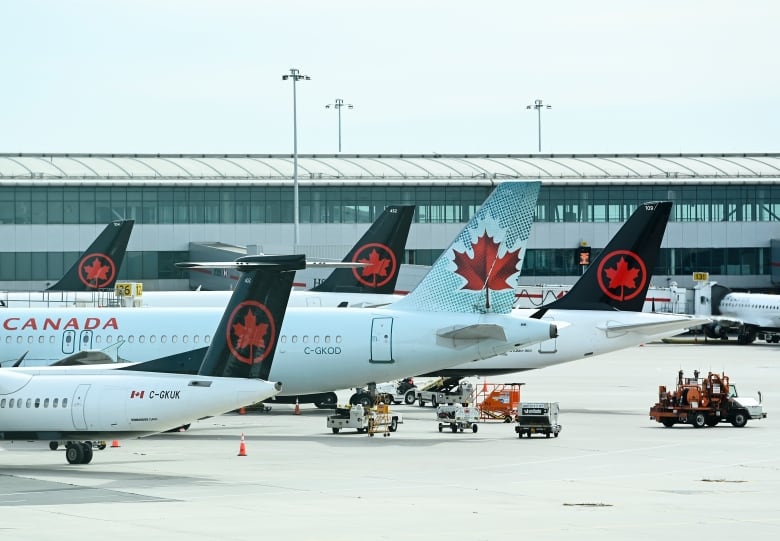
Air Canada got a federal government bailout in April 2021, on condition that customers whose flights were canceled would get refunds. (Nathan Denette/The Canadian Press)

Another big complaint is the fees travel agencies are charging to release the vouchers, says travel industry expert John Gradek, a faculty lecturer at McGill University’s aviation department.

They replace the commission agencies lose when flights get cancelled, he says, and typically range from $75 to over $200 per ticket.

“Welcome to the world of unregulated charges,” Gradek said. “[The fees are] a commercial agreement that’s in place between the airlines and the travel agencies. And the travel agencies are free to charge whatever they want.”

Many frustrated travelers who wrote Go Public blame travel agencies for giving more headaches than help.

One said he was “at an absolute loss” when it came to obtaining vouchers. Another wrote that “after four hours, they disconnected my call.” Another said his agency was “refusing to pay back” money that was completely his. Yet another claimed his travel agency was holding almost $3,000 in “hostage.”

Consumers must be persistent, Gradek said.

“Don’t procrastinate,” he said. “Always follow up with whoever got the last ping-pong — whether it’s the travel agency or the airline. The more you make a pest of yourself with either party, the sooner you get this thing settled.”

Failing that, says Gradek, they can escalate to the provincial or territorial authority that handles travel complaints.

‘Toothless tiger’

But Ontario’s regulator, TICO, can’t force an agency to reimburse a client.

It’s a “toothless tiger,” says Gradek, and needs more powers to make consumers financially whole.

“They have a nice loud roar … but when it comes to doing something that will put some money behind their actions, they seem very reluctant to want to do that.”

Smart says TICO isn’t “heavy handed,” but accomplishes a lot by facilitating discussions between frustrated customers and travel agencies. When mediation doesn’t work, its officers can lay charges and take cases to court.

“We can’t impose a settlement,” said Smart. “But we’ve recovered hundreds of thousands, millions of dollars over the years for consumers who have put complaints in.”

Gill, who filed a complaint with TICO, agrees it should have more power.

“Why are they getting [government] money if they can’t do anything to compensate the consumer?” he asked.

“They should be given the power to make them [agencies] pay back the consumer their money so that we don’t have to go through lengthy court trials.”

Despite everything, Gill says he and his family are still keen to travel — the next destination on the list is Western Canada.

“We have a lot of families in the Vancouver area,” said Gill. “That is our dream vacation.”

Gill says he’ll use his newly minted refund to take that trip, but wonders how many other Canadians are still owed vouchers from their travel agents.

“I want to spread awareness about this issue,” he said. “There may be more victims whose [vouchers] have been used by travel agencies without their knowledge.”

WATCH | Man fights back after travel agency spends his vouchers on other clients:

Man fights for $5,200 after travel agency spends airline vouchers on other clients | Go public

A Brampton, Ont., man was owed more than $5,200 in airline vouchers after his flights were canceled in the early days of the pandemic. Instead, his travel agency used them to pay for other people’s trips.

Submit your story ideas

Go Public is an investigative news segment on CBC-TV, radio and the web.

We tell your stories, shed light on wrongdoing and hold the powers that be accountable.

If you have a story in the public interest, or if you’re an insider with information, contact [email protected] with your name, contact information and a brief summary. All emails are confidential until you decide to Go Public.

Follow @CBCGoPublic on Twitter.

Read more stories by Go Public.