We’re a few weeks into the new year, which is the best time to start planning your next trip (or trips!) for 2023. Canadians across the country are back to travelling, with airports reporting some of the busiest travel dates since the start of the pandemic. But before you jump online to book your trip, here are five reasons you should use a travel agent to plan the perfect vacation.
1. Travel agents have the latest travel advice
Over the last few years, travelers have trusted the advice and guidance of travel agents to help plan their next trip. They have the latest information on travel advisories and can help you choose a safe, comfortable place to visit, and will keep you informed on changes, so you don’t face unwelcome surprises when it’s vacation time.
At CAA Travel, all consultants are CAA Travel SMART certified and have all the tools needed to plan holidays in the post-pandemic world.
2. They have your back when you need them
We’ve seen how staff shortages and increased demand have impacted travelers this past year. Over the holidays, many flights were canceled or delayed, leaving Canadians scrambling at the airport. That’s where a travel agent steps in. If something happens before you leave or while you’re away, your travel agent is ready to jump into action and help you get things sorted out. They’ll even make calls to airlines, hotels, and travel operators on your behalf – and wait on hold so you don’t have to.
3. You’ll know you’re protected with the right travel insurance
In addition to preparing the perfect trip, travel agents will make sure you have the right coverage to protect you and your wallet. Emergency medical insurance covers you and your family if you get sick or injured while traveling, helping you avoid costly medical bills. Trip cancellation and interruption insurance is growing increasingly popular among travelers, protecting Canadians from financial stress if their flights are canceled or their trip is otherwise delayed and interrupted. While credit card benefits and group plans can provide some coverage, you might need top-up insurance for your journey. A travel agent can work with you to identify any gaps in coverage and make sure you have the right policy for your trip.
It can be overwhelming with the number of coverage options available. But if you book an appointment with a CAA Travel Consultant, you can travel worry-free knowing you have comprehensive coverage with CAA Travel Insurance. And if you’re a CAA Member, you’ll also save up to 20%* on your policy.
4. They’ve seen the world and know all the best places
Whether it’s your first trip in a while or you’re a seasoned traveller, everyone can benefit from first-hand experiences. Travel agents regularly visit popular destinations and hidden gems around the world to bring you personal recommendations and insights to help you find the ideal destination.
They keep up to date with the latest travel trends and can draw from their previous trips to share insider knowledge on the best cruise lines, can’t-miss guided tours, or picture-perfect seasons to visit different parts of the world.
5. Travel agents save you time and money
We often think that shopping online helps find the lowest costs, but that isn’t always the case. Travel agents have resources most people can’t access to research, plan, and book travel arrangements, which helps them get the best travel options at the best price.
CAA Travel Consultants know the market’s best deals, the right time to book, and they’ll do the heavy lifting so all you need to do is focus on enjoying your vacation. And CAA Members get exclusive travel benefits with preferred cruise and guided tour partners.
Planning a trip is exciting, but it can be overwhelming. Whether you’re looking for a relaxing respite, an adventurous expedition, or a historic holiday, a CAA Travel Consultant can help you book the trip of your dreams. Book an appointment with a local CAA Travel Consultant today, or learn more about planning a trip with CAA Travel to get started.
CAA Travel Insurance is underwritten by Orion Travel Insurance Company, a CAA Company. Certain exclusions, limitations and restrictions apply. Subject to change without notice. A Medical Questionnaire is required if you are 60 years of age and older. Quotes are valid for 30 days.
*Applies to CAA Members in good standing (CAA Membership dues paid in full by Membership expiry date). Up to twenty percent (20%) savings applies to the total premium excluding applicable taxes. Minimum premium applies. Subject to change without notice. Excludes Visitors to Canada Insurance. CAA Everyday, Classic®, and Plus® Members save 10%. CAA Premier® Members save 20% at CAA Stores or by calling 1-800-267-8713. CAA Premier Members save 10% and earn 10% in CAA Dollars® when booking online.
® CAA trademarks are owned by, and use is authorized by, the Canadian Automobile Association.
Melbourne man Geoff Berlowitz isn’t big on holidays.
Key points:
Another Helloworld Travel franchisee has gone bust in suburban Melbourne
The collapse of the Mill Park outlet has left 56 customers out of pocket
Consumers say Helloworld’s head office has declined to help them
“I mean, Coburg would be a big trip for me,” he said with a wry smile, referring to the suburb just down the road.
So, in 2019, when he and his wife Margaret paid $22,500 for a tour to see Canada and Alaska, scheduled for May 2020, it was a big deal.
“We didn’t sort of spare any expense. We thought bugger it, let’s just spend it and have a good time,” he said.
Then the coronavirus pandemic hit in March 2020, their trip was cancelled, and they waited for their travel agent — Helloworld Travel Plenty Valley — to get them a refund or a credit from the tour operator.
“Each month it was excuse after excuse…. but the main thing he was saying was he was waiting on Evergreen [the tour operator] to return the money,” Margaret said.
But Evergreen later told the family the travel agent had only ever paid them the deposit.
The Helloworld franchisee lost $21,500 of their money, as the Mill Park business slowly went under.
In July this year, it went into liquidation, owing the Berlowitzs and 55 other customers a combined $340,000, according to administrator Mackay Goodwin.
Helen Harrison is also owed $7,000 from the travel agent.
The Harrison family — Charlotte, David, Helen, and Elise — say money which was refunded to Helloworld was not returned to them.(ABC News: Daniel Fermer)
She had booked airline tickets for her family to travel to the United States in March last year — one final family holiday before her daughters finished high school.
After she canceled the trip, she was told repeatedly by the store that the airline wasn’t issuing refunds, and she’d need to take a credit.
“So we thought, well, that’s better than nothing,” she said.
After the store went into liquidation, she was told by the airline that it had refunded her money in April this year.
Helloworld Travel Plenty Valley held on to it before going under three months later.
“Realizing that somebody actually got your money back and then didn’t bother to let you know, when you’ve been chasing it for 12 months, it’s just awful,” Ms Harrison said.
“$7,000 is a lot of money to lose … we’d saved up for a few years for it,” she said.
Helloworld Travel Plenty Valley went bust in 2020, owing $340,000 to scores of customers for holidays they were unable to take because of the pandemic.(ABC News: Daniel Fermer)
The Plenty Valley store was the latest of at least four Helloworld Travel agencies to go bust in Melbourne’s north and east.
In February, Helloworld Travel Monbulk and Bentleigh went into liquidation, owing $68 thousand to 53 clients, while in September 2020, Helloworld Belgrave went under.
The franchiser, Helloworld Travel, has 2,224 stores across Australia and is worth $280 million, but Margaret Berlowitz said when she asked the head office to give her money back, they wiped their hands of the issue.
“They virtually said ‘It’s not our problem. It’s a franchise’,” she said.
The Berlowitzs say the only reason they booked with Helloworld, and not an independent agent, was because they assumed they were dealing with a big company and their money would be safe.
“We presumed Helloworld was all one company, under one name,” Margaret said.
Helen has also been demanding that the head office give her her money back, to no avail.
“It’s just not good enough,” she said.
Helloworld Travel declined to respond to questions about the issue.
Last week, reflecting a horror 18 months for the travel industry, it posted an un-audited full-year loss of $35.9 million.
Calls for better regulation of travel agents
Consumer advocate Adam Glezer said the situation showed the need for better regulation of all travel agents, including the use of trust accounts for customer funds.
“Lawyers require them, real estate agents require them,” he said.
“Why are they not required with travel agents?”
The government-run Travel Compensation Fund (TCF) used to cover consumers in the event that a travel agency went bust, but it was abolished in 2014.
Agencies are now self-regulated, through the Australian Federation of Travel Agents (AFTA), which also represents Helloworld Travel.
In a statement, AFTA said more regulation of travel agents was not necessary and its agents had been tireless in their efforts to secure refunds and credits for people who couldn’t travel due to COVID-19.
It says travel agents who are members of the International Air Transport Association (IATA) are required by that organization to maintain a trust account for airline ticket purchases.
“Additionally, travel agents should already have a trust or client account [for other transactions],” the statement said.
“Consumer and Criminal Law applies to all agencies as with the wider population, and, while not commenting specifically on any case, remedies are already in place for breaches including for fraud.”
None of the Helloworld franchisees are facing any criminal or civil charges and no suggestion is made by the ABC that they are involved in any criminal conduct.
Mr Glezer, who runs Facebook pages for would-be travelers left in the lurch during the pandemic, believes more needs to be done to prevent travel agents spending customer money on expenses other than the holidays that customers have booked.
“What we have got to do is actually fix the problem that is in front of us to ensure this does not happen moving forward,” he said.
In June, Liberal MP Kevin Andrews put a motion to federal parliament for better regulation in the industry, which was seconded by Labor MP Michael Freelander.
The issue has stalled since then.
But for the Berlowitzs and the Harrisons, the fight with Helloworld Travel continues.
“I’m not going to let this go,” Ms Harrison said.
“Just wiping their hands of this is unacceptable.”
For Geoff Berkowitz, the experience has left such a bad taste, he said he probably wouldn’t travel overseas again.
“I’d rather spend money on something else,” he said.
Qravel agencies are facing an “existential threat” as continuing border closures mean they “don’t have any product to sell”, with business analysts predicting the phasing out of government wage subsidies is likely to mean most larger agencies survive.
However, some travel agencies, despite reporting “zero revenue” since the pandemic began and having to pay back fees for canceled holidays, hope that – by sparing their clients lengthy phone calls with airlines by negotiating refunds on their behalf – they will have demonstrated their value to customers eager to travel when restrictions allow it.
Travel websites’ surging share of holiday bookings over the past decade – Webjet recorded 52% growth in bookings between 2013 and 2019 – has seen smaller travel agencies close and larger firms move to compete with the online and corporate travel markets.
But agencies that have exclusively relied on jobkeepers are concerned they will not be able to recover like other sectors when the scheme is wound back after September.
Flight Centre’s founder and managing director, Graham Turner, told ABC radio on Tuesday the sector needed federal and state governments to be clearer on whether they were pursuing elimination or suppression, and bring certainty for what travel will be allowed.
“We really need the domestic borders open initially and then the international borders to open,” he said. “The jobkeeper helps a bit but that’s not the real issue. Our main problem we’ve got is we don’t have any product to sell.”
Flight Center founder Graham Turner says jobkeeper is not the real issue. ‘Our main problem we’ve got is we don’t have any product to sell.’ Photograph: Glenn Hunt/AAP
As a result of travel restrictions, Flight Center has had to reduce staff numbers from 22,000 to 5,000. Helloworld Travel this week launched a $50m capital-raising exercise to bolster its balance sheet, with transaction volumes expected to remain at 10%-12% of previous levels until state borders fully reopen. It has reduced operating costs from about $23m to about $2m a month, and has stood down 700 of its 1,500 staff, with the other 800 working reduced hours.
When new figures released on Thursday showed unemployment had risen to 7.4% in June, the opposition minister for employment and small business, Brendan O’Connor, held a press conference with a travel agent to call for an extension of jobkeeper to keep tourism workers employed .
Andrew Buerckner, the Melbourne travel agent appearing with O’Connor, said 23 of his 25 staff would not be employed without a jobkeeper, and predicted “98% of travel agencies in Australia would be gone” without the subsidy.
“As much as I hate the word ‘pivot’, there is very little chance for the travel industry to pivot into another area,” he said. “Hospitalities have the opportunity to look at takeaways and minimize their operations but still have incremental revenue. For us, we haven’t really had any revenue since March.”
Gloria Gammo, who runs Sydney-based luxury travel specialist GG Inspired, has relied on jobkeeper as income for her and her assistant since international borders closed at the beginning of the pandemic.
Gloria Gammo, who runs GG Inspired, has relied on jobkeeper as income for her and her assistant since international borders closed. Photograph: Gloria Gammo
She told Guardian Australia that not only had income ground to a halt, her small business “now spends all of our time repaying money back to clients” and negotiating refunds with airlines for trips that have been cancelled.
Gammo has also “been getting commission recalls on past bookings” for holidays that never go ahead.
“We now make zero revenue,” he says. “Not only are we working for free to negotiate refunds with hotels and airlines, but we’re having to pay back money, and our future revenue that we had projected is gone because you only get paid when the client stays.
“You have to make peace with how many thousands you’ve had to return.”
However, Gammo says forced cancellations of holidays have shown the value in booking through a travel agent, as they chase up refunds on behalf of clients and have their own access to booking systems.
She says clients who had their trips canceled are rebooking intrastate getaways with her, and that those who had to postpone international honeymoons are organizing domestic, multi-leg “mini-moons” in the meantime.
“I remember being on hold with Scenic tours for two hours, and this was on their line for travel agents, and then speaking to them for six hours to organize a refund for a trip happening that day,” she says. “Those clients will only ever remember what you did for them.”
Official complaints about online travel bookings have risen fourfold since the pandemic began, with the Australian Competition and Consumer Commission receiving 9,941 complaints from 1 January to the end of May, compared with 2,324 complaints in the same period in 2019.
Despite the complaints, Brian Han, a senior equity analyst at Morningstar, believes “pure bricks and mortar” stores that have become “increasingly marginalised” with the growth of online now faced an “existential threat”.
“Coronavirus has accelerated the migration of shopping behavior from physical stores to online in many sectors,” he says. “There are fewer and fewer reasons why you would physically walk into a store now, and that will extend to travel agents [when travel restrictions are lifted].”
Han says while travel agents have traditionally survived on larger commissions, “online players take a smaller cut and still do pretty well” because they don’t have to pay for real estate.
Han predicts that when pandemic-induced restrictions are lifted, “bigger players” such as Flight Center will “become even stronger because smaller agencies have fallen by the wayside” and won’t be able to hibernate their businesses for long enough to ride the wave of “pent-up demand for travel”.
He says this is because businesses such as Flight Center have already begun moving into overseas markets, building online brands (BYOJet and Aunt Betty) and targeting corporate clients.
Pierre Benckendorff, an associate professor of tourism business at the University of Queensland, also believes smaller travel agents “are in quite a bit of strife”.
“If anybody is going to survive, a big organization like Flight Centre, with deep pockets, will stand a pretty big chance,” he says.
Benckendorff says many independent travel agents based in suburban and rural centers were forced to specialize in complicated itineraries or became part of bigger chains around the time of the dotcom boom.
Han says this trend will intensify, and that most travel agents will exist for complicated, luxury trips and corporate travel.
“For a seven-stop itinerary across Africa you might think ‘bugger it I’ll go to a travel agent’,” he says. “But for a three-night trip to Melbourne, online is easier and cuts out a very expensive middleman. Why would you bother going to an agent?”
So, you’re thinking about traveling again? You’re not alone. The pandemic may not be over, but the expansion of vaccine eligibility in the United States — hiccups, delays and pauses aside — plus the news that the European Union will be opening up to vaccinated travelers is inspiring many to plan a real-deal summer vacation , or even take the leap on booking bucket-list adventures.
Travel remains far from simple, however. The virus is finding new footholds around the world, leaving an ever-changing set of rules and restrictions in its wake (and all of this is compounded by a run on home rentals, rental cars and more). It’s a reality that’s inspired many DIY-inclined travelers to consider working with a travel agent, or travel advisor, for the first time, in the hopes of skipping the travel-planning stress and focusing on actually relaxing on vacation instead.
Most travel advisors provide their services free of charge to clients (though some charge a booking fee, which can range from $25 to $100, depending on how complicated a trip you’re having) and instead make their money through commissions from hotels, tour operators , cruise lines, airlines and other travel companies.
Finding the right advisor for you is “like finding a hairdresser,” says Erika Richter, the senior communications director of ASTA, the American Society of Travel Advisors. “You want someone who understands your personal style.”
Ms. Richter, along with Misty Belles, the managing director of global public relations for Virtuoso, an international travel agency network specializing in luxury travel, shared their tips on how you can find an adviser who will understand you and your dream trip.
Begin your search close to home
Start by asking trusted friends and family members for recommendations. “The same holds true for any professional service in your life,” Ms. Belles said. “If you know someone who is working with a travel advisor and was pleased with the experience, that’s a great place to start.”
If that’s a no-go (or if your friends and family, while beloved, don’t have the same travel style as you do), Ms. Richter strongly suggested seeking out local businesses where you live.
“Supporting small businesses in our communities is more important than ever right now,” she said. ASTA has a directory that allows you to search for advisers close to you; a quick Google search will likely do the trick, too, Ms. Richter said.
Think about where you want to go
Another way to find a travel advisor is to look for one out based on a destination, or destinations, that he or she may specialize in. Are you interested in going to a specific Caribbean island nation? You’ll likely want to work with an adviser who has booked a number of trips in that country, and has connections and contacts there. Some advisors specialize in trips to Disney resort properties; others focus on cruises. If you’re interested in planning a trip outside of their purview, advisors can refer you to someone else within their network, or do the heavy-duty research themselves.
“Choosing someone who specializes in a destination is a good first foray into working with a travel advisor,” Ms. Belles said. “But when you work with the same adviser for a while, they become a specialist in you.”
Consider their professional networks
Speaking of what you want, it can be useful to understand the organization, or organizations, an adviser is associated with. Whether they work alone, with one partner in a small shop, or as part of a large agency, they are likely connected to a consortium, or a professional network, like Virtuoso, which is made up of more than 1,000 agencies in 50 countries around the world, or ASTA itself.
“Obviously, I represent ASTA, but I do think it’s important to look at an adviser’s professional affiliations,” Ms. Richter said. Affiliations can serve as a vote of confidence that the adviser has vetted; it also gives you a chance to recourse should you find yourself unhappy with your relationship (ASTA, for example, can handle consumer complaints and be a part of the resolution process). Some consortiums specialize in a certain type of travel — Virtuoso agencies focus on luxury travel, for example, while others might highlight adventure travel, or family trips and so on.
An adviser’s affiliations also act as a conduit for one of their major selling points: traveler perks.
“Ask them what kinds of benefits they get from their professional networks,” Ms. Richter said. “Upgrades, free breakfasts, late checkouts when available — who doesn’t want some of those freebies?”
Make sure your advisor understands your travel style
Do you like leisurely, slow trips? Packaged itineraries filled with sightseeing and attractions? Do you like to travel alone, or are you planning multigenerational trips with children and grandparents? Ensuring that your advisor understands what you want — and maybe even establishing that they have a similar travel style themselves — can greatly help with building rapport (and allow them to plan an even better trip for you).
Some important questions to ask: Do they charge a planning fee? What are some examples of trips that they’ve planned in the past?
“Be really upfront about your budget for a trip, and be sure that that is something they can help you make the most of,” Ms. Richter said.
Ms. Belles suggested asking the adviser how they personally like to travel, and some of their favorite destinations.
“Interview them a little bit! You can see whether there are some similarities there,” she said. But make sure they’re asking you just as many questions.
“If they’re not, that should be a red flag,” said Ms. Belles.“An adviser should be looking to get to the heart of what exactly you want as a traveler.”
The UK’s biggest package holiday company is also the best, according to more than 8,000 travelers asked to rate their beach/resort holidays in our survey.
Jet2holidays now takes nearly six million people on holiday every year – even more than long-established holiday giant Tui. Despite this rapid expansion, and the fact that its holidays are relatively cheap (just £104pp/day on average), it achieved the top customer score, alongside pricier rival, Kuoni.
Customer service proved the difference between the top performers and those further down the rankings, with holidaymakers repeatedly promoting Jet2holidays’ personal touch, reliability and consistently high levels of service. And similar praise was heaped on Kuoni – ‘nothing was too much trouble’, said one customer. Both providers have been at or near the top of our survey for years, proving a commitment to excellent service.
As holiday prices soar, you might be tempted by bargain-basement prices, but be careful: eDreams, the cheapest provider in our table also scored the lowest. It’s a holiday company we repeatedly heard complaints about, and customers didn’t feel that the holidays lived up to the way they were sold on the website; it was the only firm to get two stars for ‘description matching reality’.
Fortunately, there are plenty of options that don’t cost the earth. You can compare customer scores and prices in the table below and, for extra peace of mind, all the companies awarded Which? Recommended Provider (WRP) status guarantees that they will not apply surcharges in 2024 – so the price won’t go up after you book.
For more independent travel advice and recommendations, subscribe to Which? Travel
Best and worst beach/resort package holiday companies
Using the table In August 2022, we asked 8,361 Which? Connect panel members and the public to complete an online survey about their experiences of booking and going on holiday in the past two years. Star ratings are based on one to five stars. The more stars the better. Sample sizes are in brackets next to each holiday company. n/a indicates we did not receive enough responses to report on a company in that category. Average price Based on the median price per day of holidays taken by survey respondents, within this category, with the company named. Short-haul destinations are defined as anywhere less than a five-hour flight from London. Customer score Based on a combination of overall satisfaction and how likely people are to recommend the company
What is a package holiday?
If you buy two major elements of a holiday – flights and accommodation, for example – in a single transaction, from the same travel company, then you’ve booked a package.
Any package holiday booked in the UK automatically benefits from the Package Travel Regulations (PTRs), which help to ensure that you get the holiday you paid for.
If you’ve booked a package and it includes a flight, then you will also benefit from Atol protection.
Find out more: What is a package holiday and why should you book one?
Which beach/resort holiday companies do Which? recommend?
Jet2holidays – 84%
Jet2holidays has gone from strength to strength, and despite growing to become the UK’s biggest package tour operator, it has managed to maintain the personal touch. It specializes in beach and resort holidays along the Med, although it does do city breaks and villa holidays too.
Customers said Jet2 provided exactly what they wanted from a beach or poolside holiday, alongside exceptional customer service.
Which? verdict The joint best beach/resort holiday provider in our survey, with five-star customer service at a very reasonable price.
Read the full Jet2holidays review or visit the Jet2holidays website directly.
Kuoni – 84%
Kuoni specializes in luxury travel to resorts in exotic destinations, and you told us its high-end holidays are worth every penny.
Customers were impressed with Kuoni’s five-star customer service, accommodation and facilities.
Which? verdict: Joint top with Jet2holidays as the best beach/resort holiday provider, Kuoni is a top choice for a premium long-haul getaway.
Read the full Kuoni review or visit the Kuoni website directly.
Sunhat and flipflops at side of swimming pool
Trailfinders – 82%
Trailfinders is consistently one of the UK’s top tour operators and it specializes in adding tailor-made touches to your holiday.
Trailfinders scored well across the board and customers appreciated how well-organized their holiday was, and how well the online description matched the reality.
Which? verdict: If you’re looking for a far-flung or tailor-made beach break, Trailfinders offers five-star customer service.
Read the full Trailfinders review or visit the Trailfinders website directly.
Inghams – 81%
Inghams specializes in lake and mountain holidays.
Customers praised its fantastic organization and holiday representatives who were both helpful and knowledgeable.
Which? verdict: A very good choice for holidays in scenic locations.
Read the full Inghams review or visit the Inghams website directly.
Aerial View of Luxury Resort in Maldives, Ayada Island
Hays Travel – 80%
Hays Travel is an independent British travel agent and tour operator with more than 450 branches around the UK.
Hays Travel received a raft of five-star ratings and was commended for the time and effort taken by its advisors in finding the ideal holiday for their clients.
Which? verdict: It’s not easy to provide great customer service for holidays costing under £100 a day on average, but Hays Travel does it.
Read the full Hays Travel review or visit the Hays Travel website directly.
How we researched holiday companies
In August 2022, we asked 8,361 Which? Connect panel members and the public to complete an online survey about their experiences of booking and going on holiday in the past two years. We only reported on companies when we received at least 30 responses.
You can have your say on what we research and help us achieve change by joining Which? Connect
Fora touts itself as a modern travel agency giving individuals, even those with zero experience, the opportunity to become a travel advisor while keeping their day job. But the potential risk has seen it up its game from a free-to-join model to a quarterly subscription offering, with in-house tech, tools and advanced training.
Selene Brophy
Deploying travel advisors with zero travel booking experience sounds like a bad idea. But travel agency Fora believes it is leveling the playing field for individuals passionate about travel to earn extra income by planning and booking trips.
Skift previously reported on Fora’s ambitions to “easily recruit some 100 000” newbies to the industry after raising a total of $18.5 million in venture funding, notably $13.5 million in Series A funding in August last year.
Started as a free-to-join model, the company claims it has seen plenty of people wanting to test travel booking as a potential career change, with a 40,000-strong waiting list.
Since October last year, it has charged advisors a quarterly fee of $49 to join. A key difference with Fora is that travel advisors can join, while still keeping their main job.
Speaking to Skift about the questionable skills gap, as “97 percent of Fora’s 500 active advisors” have never booked a trip before, co-founder Henley Vazquez said their “modern travel agency isn’t about blowing up existing systems.”
Instead, she said it’s about bringing in “new supply, with new clients who have never before been engaged in the travel market.”
“Hotels are our bread and butter, but advisors can plan as much, or as little, of a traveler’s experience as they want.”
Vazquez said the company is solely focused on bringing in the right people into its network, allowing advisors to earn commission from day one and benefit from selected preferred partnerships, including the Virtuoso agency group.
Fora Advisors are onboarded through month-long training cohorts. Certified advisors then qualify for its new advanced 60-day curriculum, which is both learning and milestone-based.
Drawn to the Modern Brand
Meredith Alexander, who is midway through the first advanced training program, calls herself an almost empty nester, with one child in varsity and another set to finish high school.
Drawn to the brand she discovered on Instagram, Alexander says it was different from her fuddy-duddy perception of travel agents.
“It’s a robust community, with the ongoing support of co-advisors. The camaraderie is incredible,” she said.
Making the shift as an executive director of a non-profit, Alexander says he cannot believe how easy it has been to pick up a side hustle with a minimal cash layout.
Her biggest learning curve was being impatient to get started.
“I’m a ‘beginner-brain’ type of person and love learning, but in my first month, I booked a friend a stay at a Paris boutique hotel I had visited. It wasn’t to his liking, though.”
Alexander says the “cancellation policy was vague.” Because the hotel did not fall within the gambit of partnerships that set Fora apart for its value-adds, it was a costly lesson.
“I could lean on the support of experienced Fora advisors to complete a workaround to move my friend.”
She says her friend is still trying to secure a refund through his credit card.
Alexander has “successfully booked $30,000 in travel and is working towards a goal of $100,000 worth of travel booked in 12 months.” This would increase her commission earning capacity from six percent of the overall 10 percent commission to eight percent.
She says it wouldn’t cross her mind to branch out independently to earn the full commission.
“The support, the foundation of the team, there’s just no substitute for all the experience, backend work and partnerships.”
Advanced 60-day Curriculum Worth $6k
Vazquez stated the advanced certification, worth an estimated $6 000, is mentored by 27 existing Fora staff members with “years of travel advisor experience.”
Ross Thomason, head of training and development at Fora, said the program requires assembling a portfolio of assets outlining successes across multiple suppliers, destinations, and clients.
According to Thomason, the expertise, no matter how niche, better positions the advanced advisors to build their brand.
But what if they decide to opt out?
The company is flexible, with no performance metric terms and conditions to be completed by those who qualify.
“We have a quarterly subscription model, and advisors can cancel anytime,” said Thomason.
In-House Tech and Tools Development
Travel advisors at Fora are not the only ones upping their game. At launch, the agency didn’t have a booking system. It now has a “personalized advisor portal to track bookings, access training and utilize marketing resources.”
A community app, called Forum, connects “advisors directly with one another and other travel industry pros.”
As an added benefit, the company’s “magic feature” marketing tool creates customized marketing materials attributed to each advisor — but it does not use AI tools like ChatGPT, according to Vazquez.
A client management tool is also in the pipeline.
The desire for meaningful, flexible work is growing, and Fora clearly intends to be adaptable for its advisors.
While the average revenue data per advisor was not available at the time of publishing, the company’s more focused approach to upskilling should translate into increased booked trips and revenue.
If not, its training and advanced curriculum, all camaraderie aside, must return to the drawing board.
Miriam Henry was on a five-and-a-half-month travel adventure when she felt sick in late March.
Key points:
Travel agents are one of the worst-hit sectors in the COVID crisis and the industry is calling for $250 million in Federal Government support
Many have seen revenue plummet by over 100 per cent, while others have exited all together
There is hope international travel bans will ease, bringing much needed business back
“About a week out from coming home I started to get a small cough which I thought was something I normally get in the winter.”
Miriam’s travel agent Linda Forster quickly got her back home on one of the last flights before the international travel ban took full force.
“I arrived home on March 24, in the evening and I was in the hospital the next day,” Ms Henry said.
Confirmed as COVID-19, she had to spend 10 weeks in isolation before she got cleared with a negative test.
Ms Henry says she picked the virus up in Surrey, south-east England, and could have died if she hadn’t come back home to get proper medical care. She is now COVID-free.
“It’s been extremely stressful,” Ms Henry said.
Loading…
“I thank Linda very much for making me come home because I’m quite worried what would have happened to me had I still been in England.
“I would have probably got into a worse state and got much sicker. She [her travel agent] was my life saver.”
Ms Henry is one of millions of Australians who travel overseas each year with the help of a travel agent — in 2018-19 more than 8.1 million Australians did.
When international travel bans lift, there’s no question Ms Henry will use her travel agent to help her navigate a whole new world of travel.
But the question is, can her agent and other agents survive in the meantime?
Miriam Henry is hoping to get back to overseas travel as soon as she can, with the help of her travel agent.(Rudy De Santis)
Industry pleading for Government support
The industry is on the edge. Hundreds of travel agents have closed their shopfronts since the onset of the COVID pandemic, and many have exited the industry.
The Australian Federation of Travel Agents (AFTA) is the peak industry body for travel agents.
Its chairman Tom Manwaring, who is also CEO of Express Travel Group, has called on the Federal Government to provide the sector with a $250 million support package for 4000 travel agencies and the 40,000 Australians they employ.
“We contribute $28 billion plus each year to the economy,” he said in a recent submission.
“Without a tailored support package, businesses will start closing,” he said, estimating at least 25 per cent of the sector will close.
“That means job losses, a gap in the market that the international market will fill.”
According to Australian Small Business and Family Enterprise Ombudsman Kate Carnell travel agents are charging the costs of airline, cruise ship and hotel refunds.
Small business ombudsman Kate Carnell fears travel agents will struggle to survive.
She says they did a recent survey of hundreds of agents and 98 per cent say they have seen their revenue plunge by more than 75 per cent since COVID restrictions were introduced in March.
“More than half have told us their revenue has plummeted by over 100 per cent, meaning they have been paying more out in refunds, including previously made revenue, than they are selling in new business,” Ms Carnell said.
Small businesses in ‘hibernation’ barely hang on
Ms Forster knows that story only too well. She runs a mobile travel service, TravLin Travel, out of her home on the Mornington Peninsula.
She says business was thriving before the coronavirus pandemic, now the phones only ring when customers want help getting a refund or credit for canceled trips.
Linda Forster runs a mobile travel agency, TravLin Travel, and says business has been in hibernation because of COVID travel bans.(Rudy De Santis)
Ms Forster relies largely on international travel bookings and has placed her business in hibernation while she looks for a second job.
But she says many others have been unable to survive. She recently made a video on the dire situation, noting the number of agents that have to close their businesses.
“They’ve already left — people who have been in the industry since school — they’ve been in the industry 10, 20 30, even 40 years,” she said.
“They’ve been in a position where they’ve had to leave broken and it’s heartbreaking.”
Ms Forster has been living off JobKeeper but wants the Government to extend it — and go back to its full original rate of $1500 tonight, instead of reducing it from March.
“We’ve been through crises before in the world — we’ve had Ansett, we’ve had SARS, we’ve had the GFC, we’ve had 9/11.
“We’ve never asked the Government for help but now we really need the help now.”
‘Nothing to sell. It’s been a really tough time’
It’s not just leisure travel that’s been affected. Penny Spencer runs a corporate travel agency in Sydney, Spencer Travel.
She’s had to close two shopfronts and run her business out of head office in Mascot.
Penny Spencer runs travel agency Spencer Travel which focuses on corporate bookings. Without interstate travel, she will struggle to stay afloat.(John Gunn.)
“Pretty much overnight our business stopped,” she said.
“We have nothing to sell. We’re like a supermarket with nothing on the shelves. It’s been a really, really tough time.”
Ms Spencer has had to use her home as collateral to negotiate with the banks and spends her days negotiating with the banks and her suppliers.
“Everyday I look at my cash flow and try to work out what I can and can’t pay,” she said.
“Everyday I wake up and think, ‘what is today going to bring?’ Whether it’s going to be another shutdown of a border. Mentally it does take a toll on you.
Ms Spencer says thanks to leniency from the banks and JobKeeper “we are just surviving”. Her hope is that there will be some international travel soon.
“A couple of bubbles would be good, with New Zealand, the Pacific and possibly Singapore and Japan,” Ms Spencer said.
“That would be great, but it’s going to be slow,” she said, noting corporates are already saying they will cut down 50 per cent of travel they normally do.
“Obviously December and January are slow in corporates, so we will just have to wait and see whether corporates will travel over that period,” he said.
Ms Spencer also wants to see JobKeeper extended.
“It [JobKeeper] has been a lifesaver for everybody, especially in the travel industry,” she said.
“We need to look at what the travel industry can have after March because there is no way we will be able to put people onto full salaries after March.
“The borders will be closed to international travel and the majority of our business is international travel.”
Flight Center boss: earnings won’t hit pre-COVID levels until 2025
ASX-listed companies like Flight Center can still go to the market for extra cash. But it has also taken a huge hit, having to close more than 500 stores in Australia since the crisis.
It’s down from 950 stores in Australia to about 400 and has another 150 stores left overseas.
“We’ve had a significant downsizing and obviously there’s staff to go with that as well,” said Flight Center chief executive Graham Turner.
Flight Center CEO Graham Turner says they won’t hit pre-COVID earnings levels until 2025, but could break even by 2021-22 financial year.(Thomas Pawson)
“We started pre-COVID with about 21,000 people [employees internationally]. And were down to 6,500-7,000 at the moment.”
“We’ve kept our best locations and frontline people so that we can cope with a fair bit of business people coming back.
But he thinks it won’t be until June 2025 where their earnings lift to pre-COVID levels.
“We will have a significant loss this financial year — and it will be the year after, 2021-22 — when we should make a small profit or break even that year.”
But he says with interstate travel still largely restricted and COVID infections in North America and Europe, “it is going to take a bit of time to get back to any level of serious normality”.
“International [travel] we believe will start returning in the next six months — it will be generally bilateral arrangements — places like Japan, South Korea, perhaps China, Japan and New Zealand of course.”
But Mr Turner says his view is that we need to learn to live with the virus until a vaccine is successful, “by controlling and suppressing, not eliminating”.
“By June/July we will see much more travel coming back and will have much better protocols to protect people both before and after [getting on the plane]so the risk of traveling will be very low of either catching it on a plane or spreading it once people arrive here,” he said.
Navigating travel as COVID restrictions ease
Regardless of how soon international travel resumes, Mr Turner says there will be more agents exiting.
“A lot of small businesses in travel and tourism are really going to suffer over this next period, if they indeed survive,” Mr Turner said.
“The really low-cost ones will scrape by. And larger companies like us, who are publicly listed and can raise capital, get a reasonable cash runway …that we think will last us two to three years.
Mr Turner said Flight Center has already raised more than $700 million, “plus, another couple of hundred million in back facilities” and is considering whether it needs to raise more.
He says those who survive will have to shift to becoming even more customer-centric. This call was made months before the pandemic hit, with the collapse of British tour operator Thomas Cook.
“The industry is going to change — it’s inevitable,” Mr Turner said.
“But as things come back whether it’s business travel or leisure travel most customers are going to want the certainty that they get good advice and the way they travel is safe, so the role of the travel agent will be even more important.”
Regardless of Government support measures, Ms Spencer says the industry is going to look very different on the other side of COVID.
“We’re going to have to be like lawyers and doctors,” Ms Spencer said.
“We are going to have to know what is required when someone travels to Italy, and then goes to Germany — do they need a COVID test to get into Germany?
“What borders are going to be open to what countries? So there’s going to be a lot of extra work that we have to do.
“But I think there will definitely be fewer travel agents.”
Surinderpal Gill trusted the travel agency where he bought tickets for a family trip to India two years ago.
But then he found himself out more than $5,200 and his trust was broken.
Last June, Air Canada sent All Link Travel, based in Toronto, three vouchers to compensate Gill for returnflights that were canceled as aviation ground to a halt amid the pandemic.
But instead of telling him, Gill says the travel agency repeatedly said there was no sign of the valuable travel documents. It then used those vouchers to pay fortrips for other people.
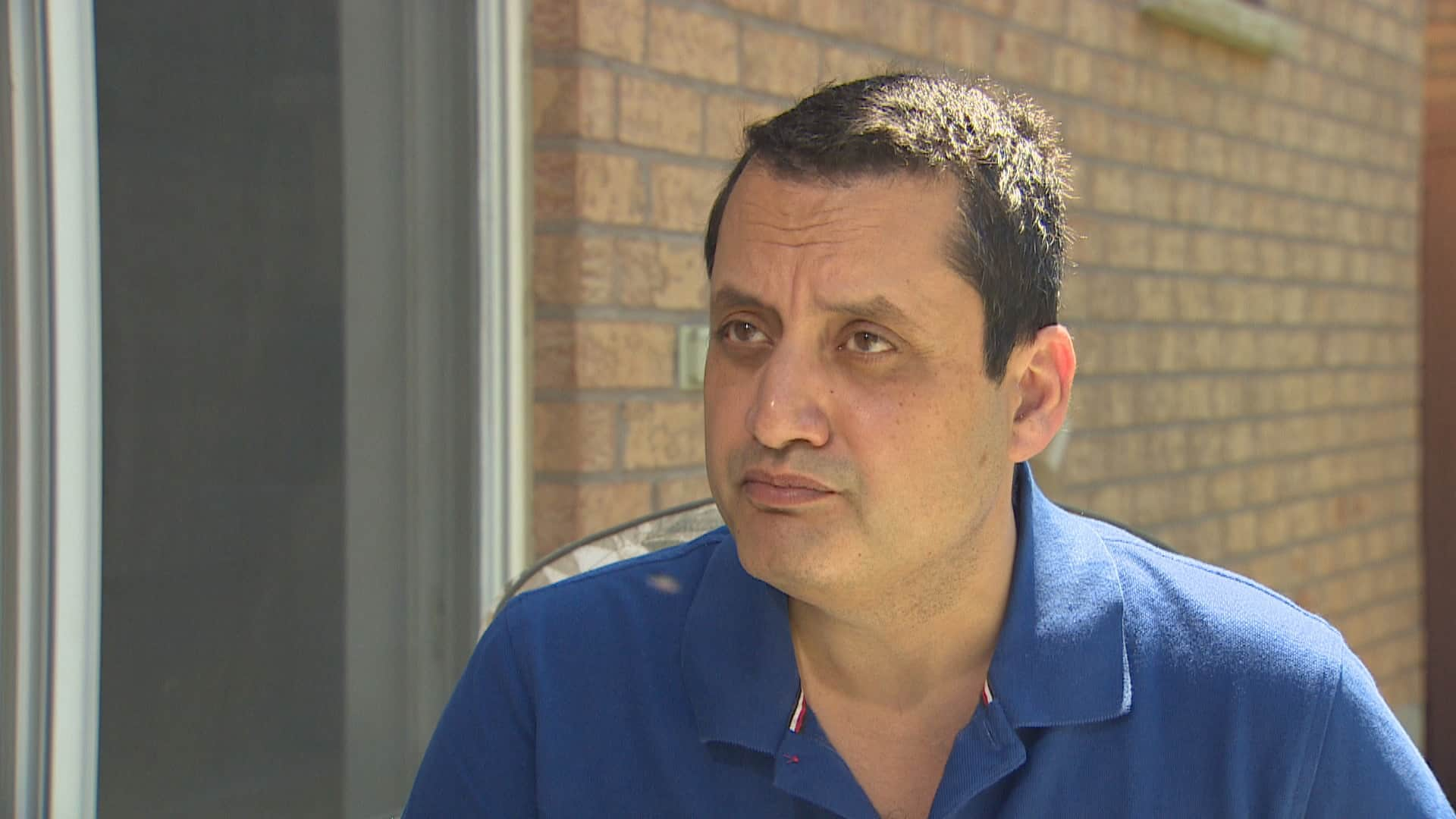
“I feel like I have been betrayed,” he told Go Public, shaking his head in disbelief in his Brampton, Ont., home. “How can somebody use my money without my consent?”
Gill is one of thousands of Canadians who’ve battled for months over travel vouchers issued amid the pandemic. Many say the very travel agencies they use are compounding their problems getting vouchers or refunds from airlines.
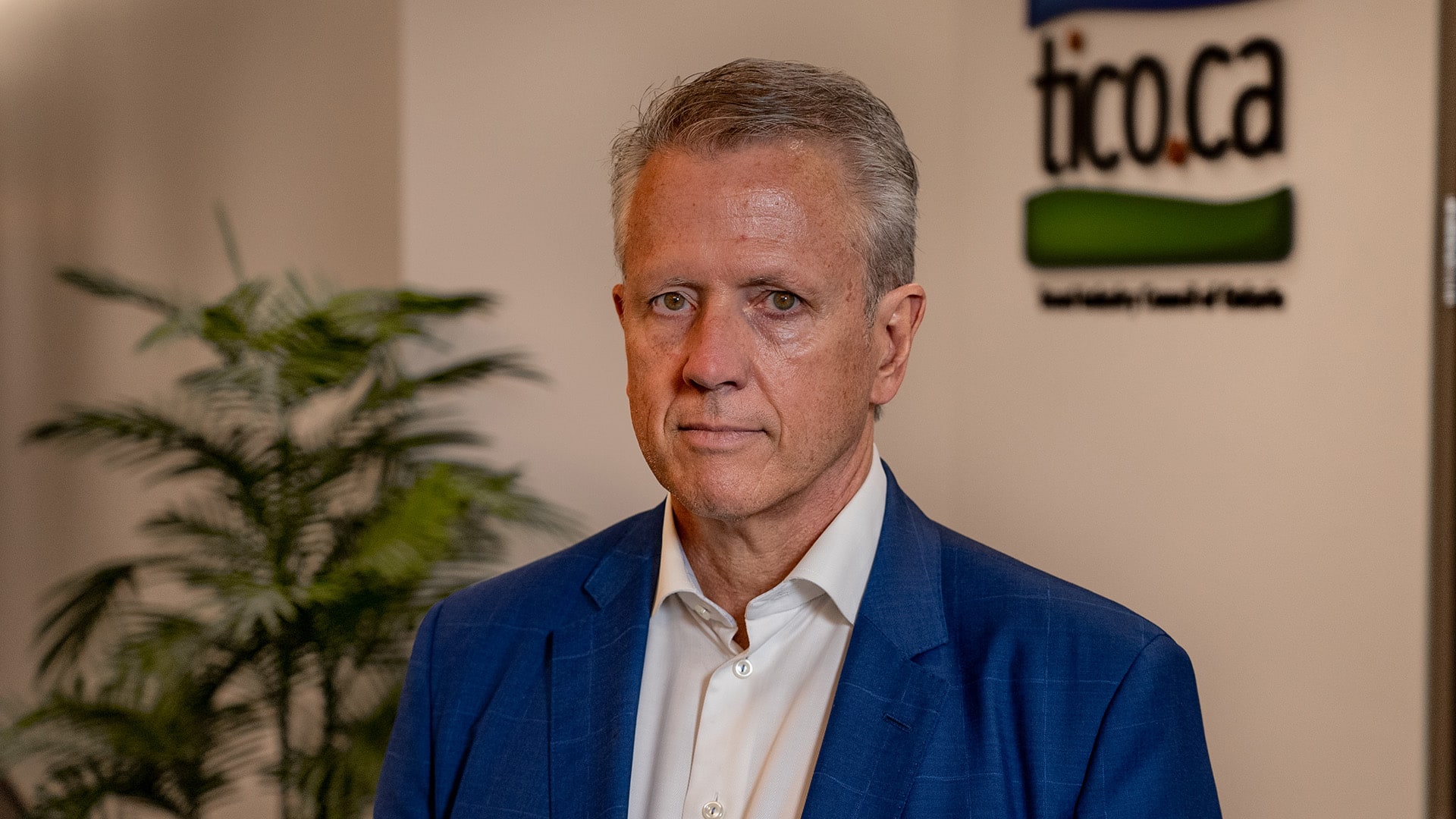
“The bane of our existence … the infamous travel voucher,” said Richard Smart, CEO and registrar of the Travel Industry Council of Ontario (TICO), which regulates travel agencies. “Complaints have gone through the roof over the last two and a half years.”
The Canadian Transportation Agency (CTA) says it, too, has received thousands of such complaints — almost 9,000 since the pandemic was officially declared in March 2020.
After Go Public got involved, the agency paid Gill.
Travel vouchers drained
Gill, his wife, two sons and five other family members were in India that March, and were desperate to find a way back to Toronto after their return flight was cancelled.
He paid almost $11,000 for four tickets to get his immediate family on a flight organized by the federal government; almost triple the usual cost.
WATCH | Fighting for his $5,200:
‘It wasn’t their money,’ says Surinderpal Gill
Surinderpal Gill was angered by his travel agency’s use of his travel vouchers for other customers, and suggested an alternative way airline refunds should be administered.
“There were no more options,” he said. “We had no choice.”
When Air Canada received a government bailout in April 2021 and promised to compensate travelers whose flights had been cancelled, Gill waited a couple of months and then called his travel agency to find out when his vouchers were coming.
“They said they don’t have any information,” said Gill.
He says he called several more times over the next few months and, each time, was told Air Canada hadn’t emailed any vouchers for him.
Last December, Gill asked Air Canada directly. He was told All Link had had the vouchers since June.
The airline sent him the same email it had sent All Link, which included a PIN, to log in and check the balance. That’s when Gill learned the vouchers — worth $5,277 — had been almost completely drained.
“I was angry,” he said. “This is misuse of money.”
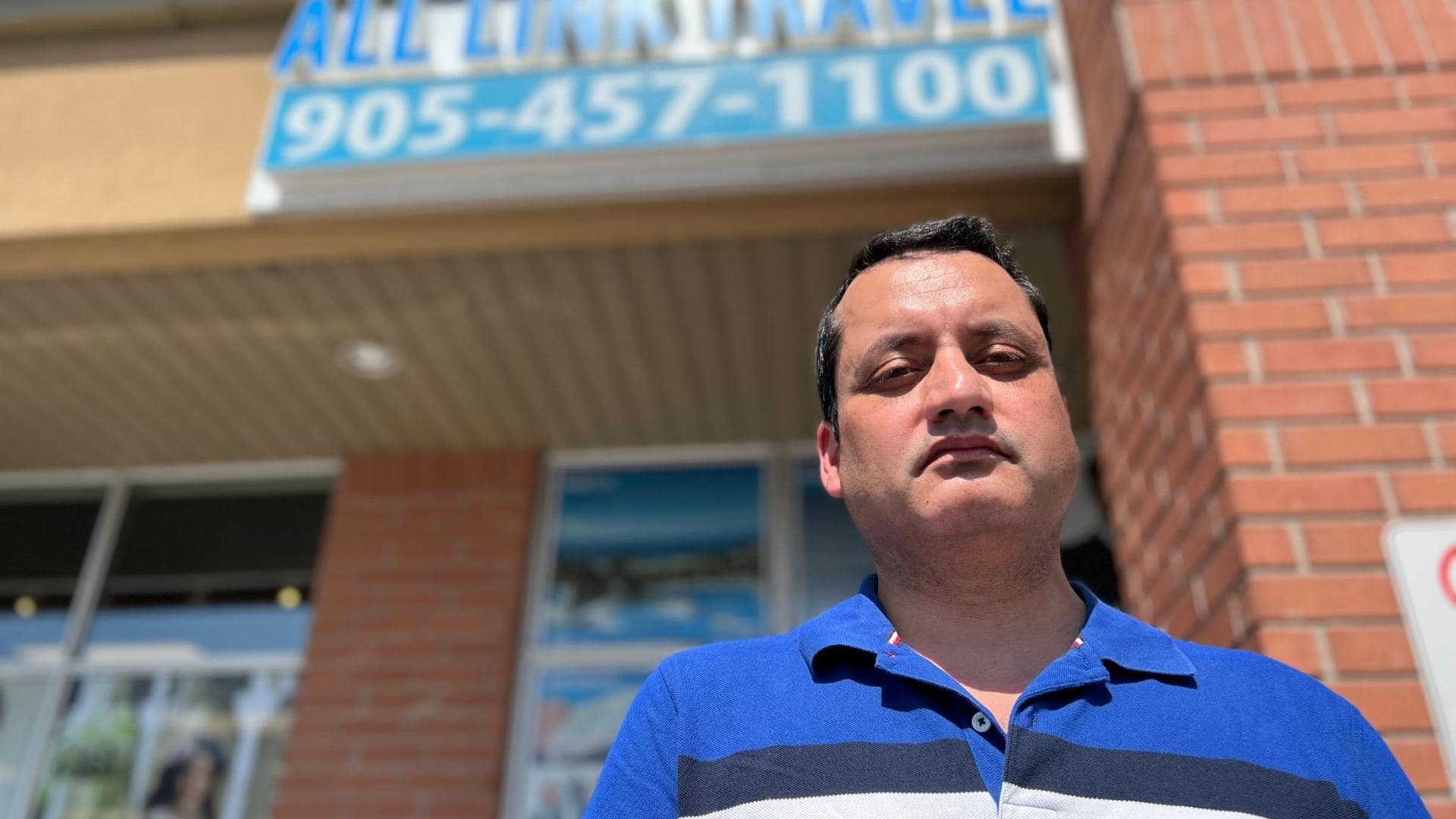
All Link Travel, in east Toronto, repeatedly told Surinderpal Gill of Brampton, Ont., the vouchers had not arrived from Air Canada. (Kimberly Ivany/CBC)
The agency claimed the vouchers had been used by mistake — three times.
“I said … ‘Don’t make up that story,'” said Gill. “‘It’s not one coupon, it’s three coupons. If it’s a mistake, write me a check.'”
Gill says the Air Canada rep confirmed the vouchers had been used to purchase airline tickets for people with an entirely different family name.
Vouchers can be used for other customers, says TICO’s Smart, but only “if the original customer gives permission.”
WATCH | When Ontario travel agencies are wrong:
TICO’s role as Ontario’s travel regulator
Richard Smart, CEO of the Travel Industry Council of Ontario, explains how the regulator lays charges.
No explanation
All Link Travel declined an interview request. Instead, a representative — who would not provide his name and called Go Public using a blocked phone number — promised several times to send a statement, but never did.
Gill says he’s grateful to have his money back, but the experience was exhausting.
“Everything has worked out,” he said. “At the same time, I still have the feeling that this should not have happened.”
One of three travel vouchers Air Canada sent All Link Travel for Gill’s canceled flights. This one had an original value of $3,656.68 — the balance is now $53.19 (Sue Goodspeed/CBC)
Gill says it’s problematic that airlines send vouchers to customers’ travel agencies. Since the email includes a booking code and PIN, agencies are able to use the vouchers.
“The travel agency has not paid for my ticket, so why is the money [voucher] going back to them?” he said.
Gill’s is not the usual type of voucher complaint TICO has received in the pandemic, says Smart.
He says the regulator has been swamped with complaints about the length of time it’s taken for travel agents to provide airline travel vouchers, the hours customers are spending on the phone dealing with agencies and airlines, and a desire for cold hard cash instead of a travel agent. credits.
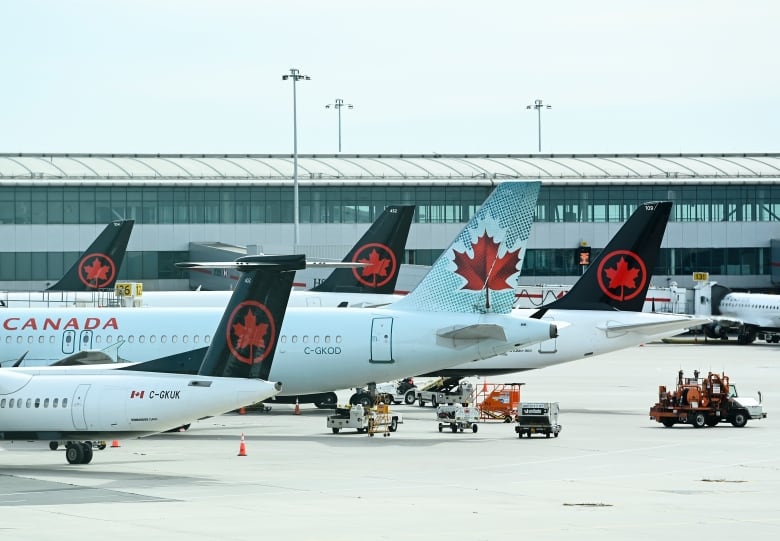
Air Canada got a federal government bailout in April 2021, on condition that customers whose flights were canceled would get refunds. (Nathan Denette/The Canadian Press)
Another big complaint is the fees travel agencies are charging to release the vouchers, says travel industry expert John Gradek, a faculty lecturer at McGill University’s aviation department.
They replace the commission agencies lose when flights get cancelled, he says, and typically range from $75 to over $200 per ticket.
“Welcome to the world of unregulated charges,” Gradek said. “[The fees are] a commercial agreement that’s in place between the airlines and the travel agencies. And the travel agencies are free to charge whatever they want.”
Many frustrated travelers who wrote Go Public blame travel agencies for giving more headaches than help.
One said he was “at an absolute loss” when it came to obtaining vouchers. Another wrote that “after four hours, they disconnected my call.” Another said his agency was “refusing to pay back” money that was completely his. Yet another claimed his travel agency was holding almost $3,000 in “hostage.”
Consumers must be persistent, Gradek said.
“Don’t procrastinate,” he said. “Always follow up with whoever got the last ping-pong — whether it’s the travel agency or the airline. The more you make a pest of yourself with either party, the sooner you get this thing settled.”
Failing that, says Gradek, they can escalate to the provincial or territorial authority that handles travel complaints.
‘Toothless tiger’
But Ontario’s regulator, TICO, can’t force an agency to reimburse a client.
It’s a “toothless tiger,” says Gradek, and needs more powers to make consumers financially whole.
“They have a nice loud roar … but when it comes to doing something that will put some money behind their actions, they seem very reluctant to want to do that.”
Smart says TICO isn’t “heavy handed,” but accomplishes a lot by facilitating discussions between frustrated customers and travel agencies. When mediation doesn’t work, its officers can lay charges and take cases to court.
“We can’t impose a settlement,” said Smart. “But we’ve recovered hundreds of thousands, millions of dollars over the years for consumers who have put complaints in.”
Gill, who filed a complaint with TICO, agrees it should have more power.
“Why are they getting [government] money if they can’t do anything to compensate the consumer?” he asked.
“They should be given the power to make them [agencies] pay back the consumer their money so that we don’t have to go through lengthy court trials.”
Despite everything, Gill says he and his family are still keen to travel — the next destination on the list is Western Canada.
“We have a lot of families in the Vancouver area,” said Gill. “That is our dream vacation.”
Gill says he’ll use his newly minted refund to take that trip, but wonders how many other Canadians are still owed vouchers from their travel agents.
“I want to spread awareness about this issue,” he said. “There may be more victims whose [vouchers] have been used by travel agencies without their knowledge.”
WATCH | Man fights back after travel agency spends his vouchers on other clients:
Man fights for $5,200 after travel agency spends airline vouchers on other clients | Go public
A Brampton, Ont., man was owed more than $5,200 in airline vouchers after his flights were canceled in the early days of the pandemic. Instead, his travel agency used them to pay for other people’s trips.
Submit your story ideas
Go Public is an investigative news segment on CBC-TV, radio and the web.
We tell your stories, shed light on wrongdoing and hold the powers that be accountable.
If you have a story in the public interest, or if you’re an insider with information, contact [email protected] with your name, contact information and a brief summary. All emails are confidential until you decide to Go Public.