
The Great School Ranking Mirage: Why Your Obsession with the “Top 10” Might Be Hurting Your Kids
I still remember the look on a parent’s face a few years back during a consultation. She held a printed spreadsheet, highlighted in three different colors, cross-referencing the latest national rankings with average starting salaries and Ivy League feeder rates. She was terrified. To her, a drop from rank #12 to rank #28 wasn’t just a statistical fluctuation; it was a death sentence for her child’s future. It’s a scene I’ve witnessed countless times in my decade of navigating the education sector. We have become a culture obsessed with the leaderboard, treating schools like they are stocks on the NASDAQ rather than living, breathing communities of learning.
Let’s be honest. Rankings are seductive. They provide a neat, numerical solution to an impossibly complex question: “Where will my child thrive?” But after years of looking behind the curtain, I’ve realized that these lists are often more about marketing and institutional ego than they are about the quality of a student’s day-to-day experience. We are chasing a ghost of prestige while the actual substance of education evaporates in the background.
The Architecture of a Lie
To understand why these rankings are flawed, you have to look at how the sausage is made. Most major ranking systems rely heavily on “reputation surveys.” This is essentially a popularity contest where administrators at one school rate other schools they may have never even visited. It’s a feedback loop of brand recognition. If a school was famous fifty years ago, it stays famous today because the people voting grew up hearing it was famous. It has nothing to do with the innovative curriculum they implemented last Tuesday or the fact that their mental health support system is currently crumbling.
Then there’s the data gaming. I’ve seen schools pour millions into “beautification” projects or administrative bloat just to tick boxes that the algorithms love. They might reject perfectly qualified students just to lower their acceptance rate, because “exclusivity” is equated with “excellence” in the eyes of a computer program. It’s a race to the bottom of a very high-quality pit. When a school’s primary goal is to move up three spots on a list, the actual human beings in the classrooms—the students—become secondary to the metrics. I’ve spoken with teachers at “Top 5” institutions who are burnt out and restricted by rigid, outdated syllabi designed solely to produce high test scores that keep the ranking high. It’s a sterile environment that prioritizes the data point over the person.
The Prestige Tax and the Big Fish Myth
There is a hidden cost to chasing the top of the list, and I’m not just talking about the astronomical tuition. I call it the “Prestige Tax.” It’s the psychological and emotional toll on a student who is forced into a high-pressure environment that doesn’t actually fit their learning style, all for the sake of the name on the sweatshirt. We’ve been conditioned to believe that a degree from a #1 ranked school is a golden ticket. In reality, being a “small fish in a big, elite pond” can be devastating. I’ve mentored brilliant kids who went to top-tier universities and felt like failures because they were surrounded by other “alpha” students, losing their confidence and their love for their subject in the process.
Contrast that with the student who chooses a #75 ranked school because it has the exact lab equipment they need, or a mentor who actually remembers their name. That student becomes the “Big Fish in a Little Pond.” They get the research opportunities, the leadership roles, and the personalized attention. Ten years later, that “lower-ranked” graduate is often more successful, more confident, and—crucially—less traumatized than the one who survived the prestige meat-grinder. The algorithm can’t measure the value of a professor who invites a student for coffee to discuss a struggling thesis. It can’t measure the vibe of a campus green where students actually look happy rather than caffeinated and panicked.
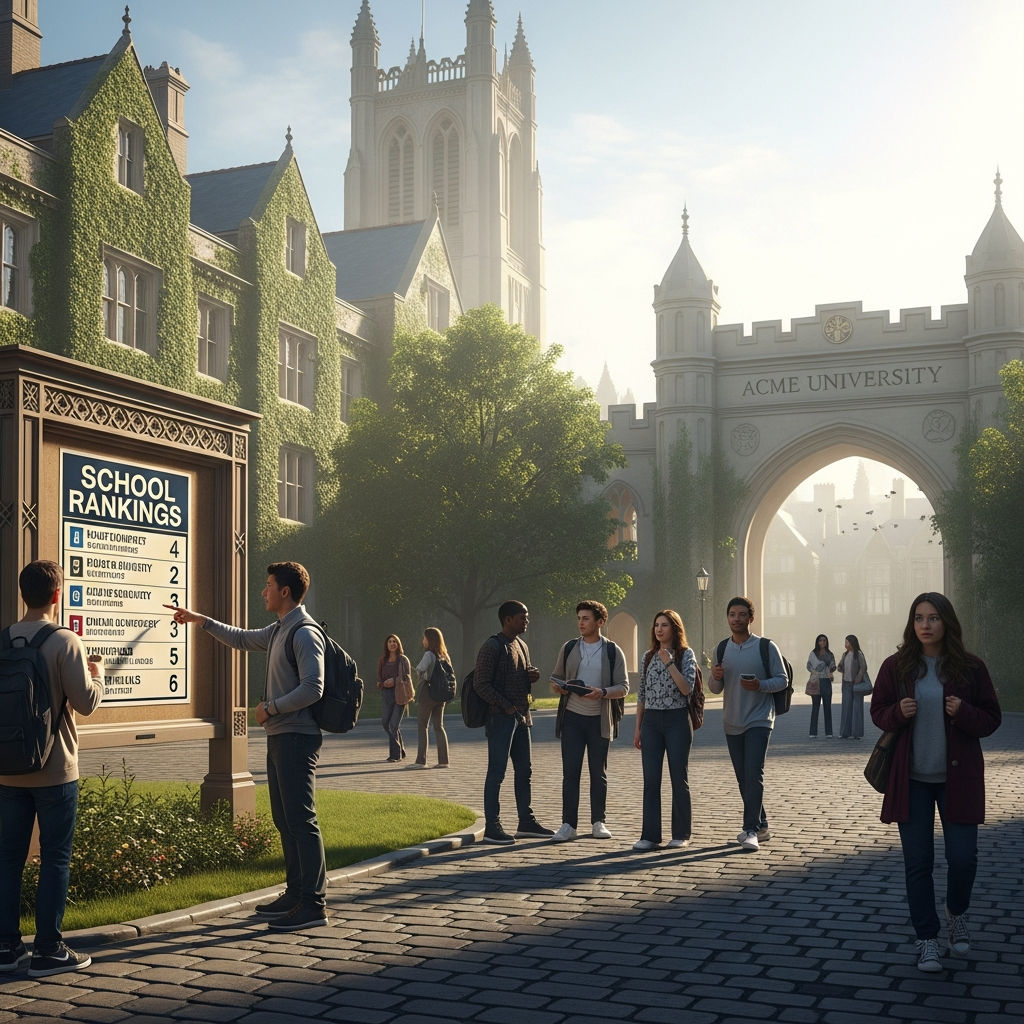
What the Spreadsheets Miss
If you want to know if a school is good, stop looking at the glossy brochures and start looking at the friction points. Every school has them. I always tell parents to ignore the “student-to-faculty ratio” because that number is easily manipulated by including research staff who never step foot in a classroom. Instead, look at the turnover rate of the faculty. Do teachers stay there for ten years, or is it a revolving door of exhausted adjuncts? Stability is a much better indicator of a healthy learning environment than a bloated endowment.
Think about the “fit” in terms of sensory and social needs. Some kids need the chaotic energy of a massive urban campus to feel alive. Others will curl up and die if they don’t have a quiet, green space and a tight-knit cohort. Rankings treat every student like a generic unit of “potential” that needs to be processed. But education is an artisanal process, not an industrial one. When we let a magazine tell us where our children belong, we are outsourcing one of the most intimate decisions a family can make to a group of data scientists who have never met our kids.
Breaking the Cycle of Comparison
The hardest part of moving away from rankings is the social pressure. There’s a certain “country club” status that comes with saying your child goes to a top-ranked school. It’s a badge for the parents as much as it is for the kids. I’ve been in those dinner parties where the “where is your son going?” question feels like a competitive sport. It takes a tremendous amount of courage to say, “He’s going to this small college you’ve never heard of because they have the best undergraduate underwater robotics program in the country.”
We need to start valuing the “Value Added” metric—not the financial one, but the human one. How much does a student grow between freshman and senior year? Does the school take a “B” student and turn them into a visionary, or does it just take “A+” students and try not to break them? Most top-ranked schools are the latter. They are finishing schools for the already-successful. The real magic happens in the schools that the rankings often overlook—the places that actually teach, mentor, and transform.
If I could give one piece of advice to anyone currently refreshing a ranking page, it would be this: Close the tab. Go visit the campus. Don’t take the official tour; sit in the cafeteria and listen to the students talk. Are they complaining about the curve, or are they arguing about an idea they heard in class? Do they look like they’ve slept in the last 48 hours? Trust your gut over the grid. Your child isn’t a data point, and their future shouldn’t be dictated by a flawed algorithm designed to sell magazines and boost institutional pride. The best school in the world is the one where your child feels seen, challenged, and supported—and that’s a number that no ranking will ever be able to calculate.
