
The Raw Reality of Shared Living: Surviving and Thriving in Dormitory Culture
Forget the glossy brochures showing two smiling students sitting perfectly cross-legged on color-coordinated bedspreads. That is a lie sold by marketing departments to parents who are about to cut a very large check. Real dorm life is grittier, louder, and infinitely more complicated than any staged photo could ever suggest. It is a strange, pressurized social experiment where you are shoved into a cinderblock box with a complete stranger and expected to figure out how to be an adult while your laundry festers in a corner. I spent four years navigating these hallways—first as a wide-eyed freshman and later as a cynical resident advisor—and if there is one thing I have learned, it is that the real education doesn’t happen in the lecture hall. It happens at 2:00 AM when the fire alarm goes off because someone tried to grilled-cheese a sandwich with a clothing iron.
The first thing no one tells you is the smell. Every dorm has a distinct olfactory signature—a mix of industrial-grade floor wax, stale popcorn, and the lingering scent of damp towels that never quite dried. On move-in day, you walk into that 10-by-12-foot space and realize this is the smallest your world will ever be. It is a shock to the system. You are used to having a door you can lock to keep the world out, but in a dorm, the world is always knocking. Or worse, it’s just sitting there on the other side of the room, breathing. This lack of privacy is the most immediate hurdle. You have to learn the delicate art of the “invisible wall,” that unspoken agreement where you pretend your roommate isn’t there so they can have a private phone call, while you stare intently at a textbook you haven’t actually read in three weeks.
The Roommate Roulette and the Art of Conflict
People talk about roommate horror stories like they’re urban legends, but most of them are deeply, boringly true. You might get lucky and find a lifelong friend, but more often than not, you find a person who has fundamentally different ideas about what constitutes “clean.” I once had a roommate who thought empty pizza boxes were legitimate decorative elements. We didn’t fight with shouts; we fought with passive-aggressive Post-it notes and the volume of our respective headphones. It sounds petty because it is. But this pettiness is actually a masterclass in diplomacy. You learn to negotiate boundaries that you never knew you had. You learn when to stand your ground on a 1 AM lights-out policy and when to let the dishes slide for another night because your roommate just bombed a chemistry midterm and needs a break.
I’ve seen people try to bypass this struggle by living with their best friend from high school. Let me be the one to tell you: don’t do it. It is the fastest way to turn a decade of friendship into a bitter rivalry. There is something about sharing a sink and a trash can that strips away the social graces of friendship and replaces them with cold, hard logistics. If you live with a stranger, you have the benefit of a professional distance. You can set rules without feeling like you’re betraying a bond. Dorm life works best when you treat it like a co-working space that just happens to have beds. If you happen to become friends along the way, that’s a bonus, not a requirement. The goal isn’t soul-bonding; the goal is peaceful coexistence.
The Communal Bathroom Rite of Passage
We need to talk about the showers. There is no way to romanticize a communal bathroom. Walking down a hallway in a bathrobe, clutching a plastic caddy filled with soggy soap bottles, is the ultimate equalizer. You will see people at their absolute worst—exhausted, tooth-brushing, bed-headed versions of themselves. It kills any sense of mystery or pretension. You learn very quickly to invest in the highest quality shower shoes money can buy because the things growing on those tile floors likely haven’t been identified by science yet. It’s a strange communal vulnerability that, oddly enough, breeds a specific kind of kinship. You’ll have the most profound philosophical debates of your life while standing in line for a vacant stall or waiting for a sink to open up.
I’ve often thought that corporate HR departments should just replace their team-building retreats with a week in a freshman dorm. If you can navigate the politics of who left the hair in the drain or who used all the paper towels, you can navigate any boardroom in the country. There’s a certain grit you develop when your morning routine is dictated by the occupancy of twelve other people. It forces you to be efficient, to be patient, and to develop a very thick skin. You stop caring about the little things because, in the grand scheme of dorm survival, a cold shower is just another Tuesday.
The Myth of the Quiet Study Space
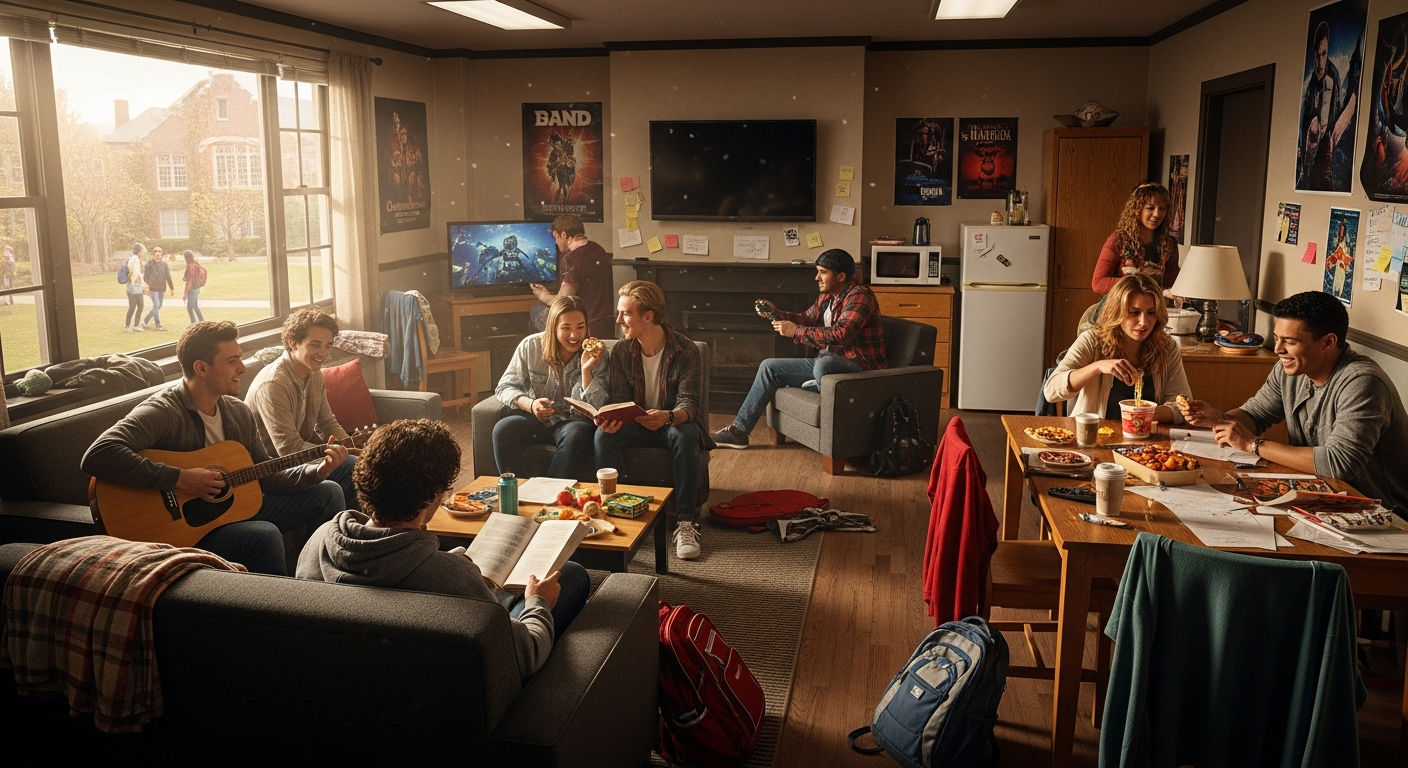
If you think you are going to get serious academic work done in your room, you are delusional. The dorm is a sensory minefield. There is always a bassline thumping through the wall from three doors down, someone laughing hysterically in the lounge, and the constant hum of the vending machine. Your room is a place for sleeping, occasional snacking, and staring at the ceiling while questioning your life choices. For actual studying, you have to find a “third space”—the library, a quiet corner of the student union, or a basement coffee shop that smells like roasted beans and despair. The dorm is for social integration, not scholarly isolation.
The social pressure is the hidden tax of dorm life. There’s a constant feeling that if you aren’t out in the lounge or hanging out in someone else’s room, you’re missing the “college experience.” This FOMO is exhausting. I remember feeling guilty for just wanting to watch a movie by myself on a Tuesday night. But here’s the secret: everyone else is just as overwhelmed as you are. They are just better at hiding it behind a veneer of forced sociability. The most successful dorm dwellers are those who learn to say no. They realize that they don’t have to be part of every late-night taco run or every impromptu Mario Kart tournament to be “part of the community.” Setting those personal boundaries is the first real step toward adulthood.
Survival Electronics and the Microwave Gourmet
Let’s get practical for a second. Your dorm room is basically an electrified closet. You will spend more time thinking about power strip placement than you ever did about your high school GPA. Everything revolves around the “Big Three”: the mini-fridge, the microwave, and the laptop charger. I’ve seen people try to bring air fryers, hot plates, and elaborate coffee stations, only to have them confiscated by an RA during a surprise inspection. It’s a game of cat and mouse. But the reality is, you don’t need much. You become an expert at “microwave gourmet”—learning exactly how many seconds it takes to heat up a bowl of ramen without it turning into a gelatinous mess, or how to revive a day-old slice of pizza using a damp paper towel.
This forced minimalism is actually a gift. You realize how much junk you don’t actually need. When your entire life has to fit into a space smaller than some people’s walk-in closets, you start to value utility over aesthetic. You stop buying things because they look cool and start buying them because they serve three different purposes. That foldable chair? It’s a guest bed, a laundry rack, and a desk chair. That trunk at the foot of your bed? It’s a table, a ladder, and a storage unit. It’s a crash course in essentialism that stays with you long after you’ve moved out into a “real” apartment with multiple rooms and a functioning kitchen.
The End of the Hall
By the time May rolls around and you’re packing your life back into cardboard boxes, the room feels different. The cinderblock walls don’t look quite so cold, and the smell—while still there—has become a familiar background note. You’ve survived the roommates, the fire alarms, the communal showers, and the sheer, unadulterated noise of a hundred teenagers trying to figure out who they are. You aren’t the same person who walked in with those crisp new sheets in August. You’re a little more tired, definitely more cynical, but significantly more capable. Dorm life is a mess. It’s loud, it’s cramped, and it’s frequently annoying. But it’s also the only time in your life you’ll be surrounded by hundreds of people in the exact same boat as you, all struggling, all learning, and all just trying to get through the night. It’s a beautiful, chaotic disaster, and I wouldn’t trade my time in those trenches for anything.
